
'/%3E%3C/svg%3E)

'/%3E%3Cpath%20fill='%23b2b2b2'%20d='M241%20382q0%2016%2017%2026%2017%2011%2042%2011t42-11q16-11%2017-26V269H241'/%3E%3Cpath%20fill='%239f7e00'%20d='M241%20379q0%2014%208%2023%209%209%2021%209%2014%200%2021-9%209-9%209-23V269h-59'/%3E%3Cpath%20d='M241%20339v-70h59v110q0%2014-9%2023l-6%205v-68h-15v72q-8%200-14-4v-68zm59%2040c0%2022%2015%2032%2029%2032%2021%200%2030-18%2030-32v-40h-59'/%3E%3Cpath%20fill='%239f7e00'%20d='M266%20277v5h2v12h-3v-5h2v-5h-9v5h2v5h-4v9h3v18h-5v10h34v-10h-5v-18h3v-9h-4v-5h2v-5h-9v5h2v5h-3v-12h2v-5zm42%20101q0%2010%206%2017%206%206%2015%207%2010-1%2016-7%206-7%206-17v-29h-43'/%3E%3Ccircle%20fill='%230044ad'%20cx='329.5'%20cy='372'%20r='6'/%3E%3Cellipse%20fill='%230044ad'%20cx='300'%20cy='340'%20rx='16'%20ry='21'/%3E%3C/svg%3E)


'/%3E%3C/g%3E%3Cuse%20href='%23c'%20transform='matrix(-1%200%200%201%20720%200)'/%3E%3C/svg%3E)





Production & Warehouse &
Operations Facilities
Providing efficient storage, logistics coordination, and operational support throughout the region.
For Sensitive Skin
Gentle Cleansing Care
Actolind Foam supports practical and gentle body cleansing in professional care settings, helping caregivers perform daily hygiene practices comfortably and effectively.
With Actolind Gel Plus
Professional Wound Management
A professional wound gel developed to support wound bed preparation, moist wound care, and the management of wound environments prone to biofilm formation.
With Actolind Solution Plus
Effective Wound Cleansing
Actolind Solution Plus is designed to support wound cleansing, irrigation, and wound bed preparation procedures in professional healthcare settings.
Supporting Professional Wound Care
with Reliable Solutions
Actolind® wound care products have been developed for professional wound cleansing, irrigation, gel application, and supportive wound management routines. This portfolio is designed to support healthcare professionals with practical, documented, and quality-focused solutions.

Technology

Core Wound Care Areas
Actolind® provides professional wound care solutions developed for wound cleansing, wound irrigation, wound gel application and supportive wound management routines in clinical and healthcare environments.
Wound
Cleansing
Wound cleansing helps remove debris, exudate and unwanted residues from the wound area as part of professional wound bed preparation.
Wound Healing
Support
Explore educational resources on wound healing phases, moist wound care, dressing selection and continuity of professional wound management.
Biofilm
Awareness
Biofilm can be a major challenge in wound care. Learn how cleansing, irrigation and wound bed preparation contribute to professional care routines.
Chronic Wound
Care
Chronic wounds require structured care, regular assessment and appropriate wound management strategies to support the healing process.
Diabetic Foot
Care
Access educational content on diabetic foot risk awareness, wound monitoring and professional care pathways for patients with complex wound needs.
Professional Wound Care Products
The Actolind® product portfolio includes wound care products for wound cleansing, irrigation, moisturization, protection, and care applications, as well as products for body cleansing.


ACTOLIND® SOLUTION PLUS
View product details- A cleansing, irrigation, moisturizing and care solution for wounds.
- Contains Polyhexanide and Poloxamer to support advanced wound care.
- Designed to support the management of wound environments prone to biofilm formation.
- Supports the cleansing of acute, chronic, thermal, chemical, electrically induced and radiation wounds.
- Suitable for infected and non-infected wounds.
- Helps loosen debris, contaminants and necrotic residues.
- Supports gentle wound cleansing with good tissue tolerance.
- Helps maintain a moist wound environment.
- Can be used to moisten dressings, pads and compresses.
- A Class III Medical Device intended for professional wound care.


ACTOLIND® GEL PLUS
View product details- Formulated with polyhexanide (PHMB) to provide effective antimicrobial wound protection
- Contains poloxamer to gently cleanse the wound bed and reduce surface tension
- Supports the acceleration of natural healing processes by maintaining an optimally moist environment
- Forms a stable protective barrier layer on the wound surface against external contaminants
- Highly effective in preventing and reducing biofilm formation in chronic and infected wounds
- Ideal for the care of acute, chronic, and infected wounds, as well as 1st- and 2nd-degree burns
- Supports the painless and gentle removal of adhered or encrusted dressing materials
- Offers superior tissue compatibility and is suitable for long-term wound care routines
- Does not impede essential natural healing processes such as granulation and epithelialization
- A Class III-certified Medical Device developed for professional and reliable wound management


ACTOLIND® W SOLUTION
View product details- Helps remove dirt, debris, and microorganisms from the wound surface through poloxamer.
- Helps reduce microorganisms through polyhexanide (PHMB).
- Helps keep the wound surface moist, supporting a suitable wound care environment.
- Supports the care process by acting gently on wound tissue.
- Helps soften dried and adhered dressing materials.
- Supports the gentle removal of dressings without causing secondary trauma.
- Supports the control of biofilm formation and microbial load.
- Helps maintain a suitable wound care environment that supports the granulation and epithelialization processes.
- Supports moist wound care conditions. Provides wound care support suitable for long-term use.
- Compatible with modern wound dressings.


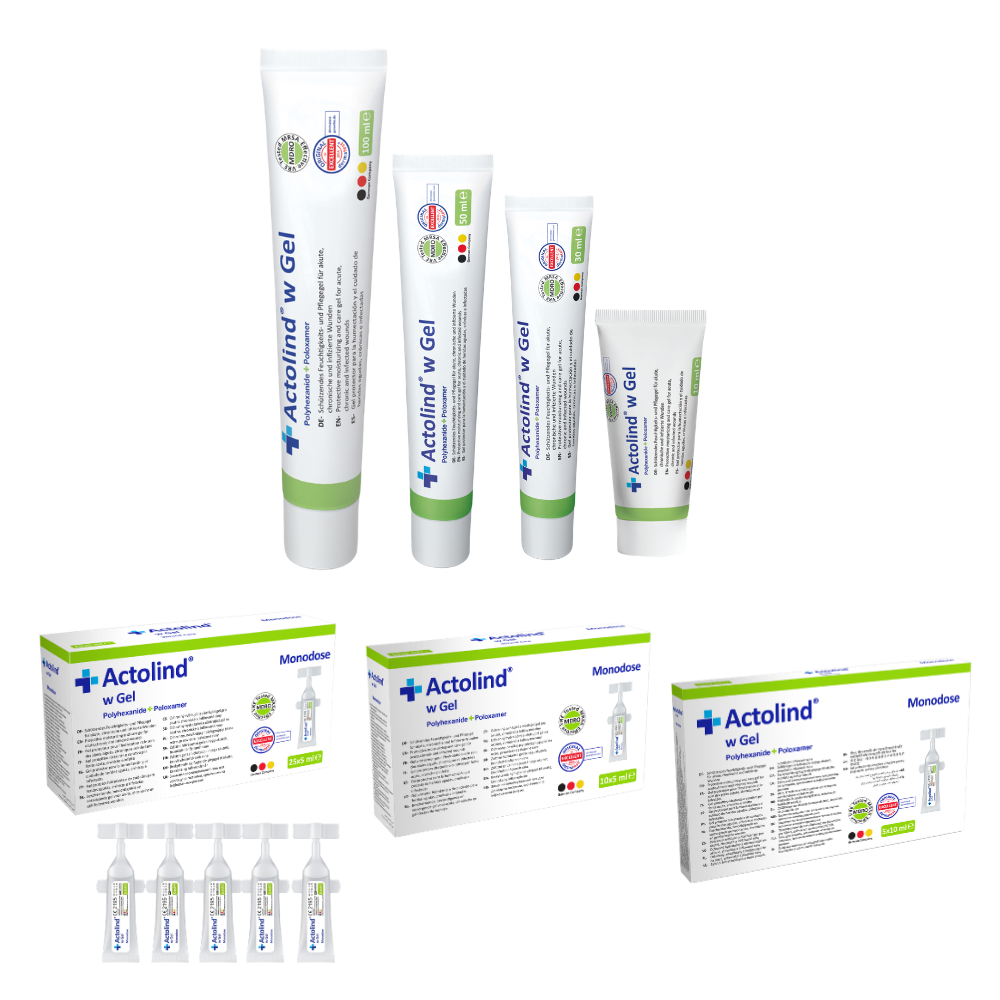
ACTOLIND® W GEL
View product details- Supports antimicrobial activity.
- Helps control biofilm formation.
- Supports the reduction of the microbial load.
- Helps keep the wound surface clean and moist.
- Supports the maintenance of a suitable moist wound environment.
- Helps create a barrier between the wound and the dressing.
- Helps protect the wound bed.
- Contributes to maintaining a suitable wound environment that supports the development of granulation and epithelialization tissue.
- Supports wound care for wounds prone to biofilm formation.
- Compatible with modern wound dressings.

ACTOLIND® GLOVE
View product details- Formulated with Polyhexanide (PHMB) to provide reliable antimicrobial skin protection and decontamination
- Contains Allantoin and Panthenol to intensely soothe, deeply moisturize, and support skin regeneration
- Designed for gentle, completely waterless, and rinse-free full-body cleansing and patient hygiene
- Rich ready-to-use foam formula simplifies daily care for bedridden, intensive care, or immobility patients
- Effectively breaks down and eliminates unpleasant body odors while leaving a fresh, clean feeling
- Helps maintain the skin's natural protective moisture barrier with an optimized physiological pH 5.5
- Soft, non-irritating glove material guarantees high surface comfort and delicate contact with fragile skin
- Offers high tissue compatibility, dermatologically tested, and free from aggressive artificial colors
- Provides optimal barrier support against external contaminants and modern hospital pathogens
- Saves valuable preparation time and minimizes cross-contamination risks in clinical environments


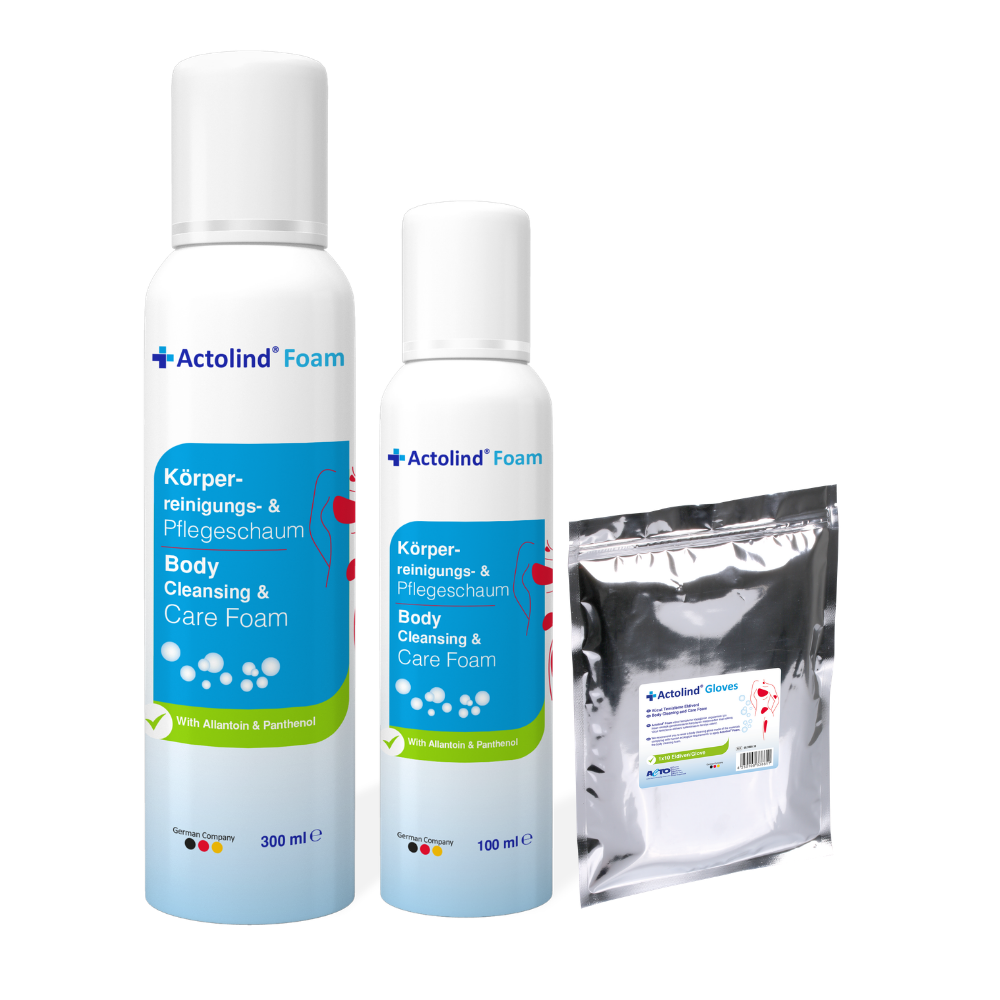
ACTOLIND® FOAM
View product details- Formulated with Polyhexamethylene Biguanide (PHMB), providing broad-spectrum antimicrobial protection on the skin surface
- Contains Allantoin and Panthenol to nourish, deeply moisturize, and soothe damaged skin
- Designed for gentle, completely waterless full-body patient cleansing without the need for rinsing
- Ready-to-use, stable foam texture enables precise application without dripping or spilling
- Effectively traps and neutralizes unpleasant body, sweat, and incontinence (urine/feces) odors
- With a physiological pH of 5.5, supports and protects the skin’s natural acidic protective mantle
- Minimizes friction on sensitive or geriatric skin, reducing the risk of irritation and pressure ulcers
- Dermatologically tested, highly skin-compatible, and suitable for long-term daily hygiene
- Ideal for the cleansing routines of bedridden, intensive care, orthopedic, and mobility-impaired patients
- Significantly reduces the risk of cross-contamination in clinical settings while easing the workload of care staff
Documented Wound Care Support for International Healthcare Markets
Actolind® supports healthcare professionals, hospitals, distributors and clinical partners with documented wound care products, regulatory information and product-specific technical documentation for professional wound care routines.
Actolind® product registrations are documented across multiple international healthcare markets.
Actolind® w Solution, w Gel, Solution Plus and Gel Plus are supported with product documentation.
Product registration information is supported by ACTO GmbH Regulatory Affairs documentation.
ACTO GmbH regulatory documentation includes notified body confirmation and CE/MDR transition references.
Case Studies by Actolind®
Explore selected wound care case resources based on clinical experience, professional documentation and case materials involving Actolind® wound care solutions.
 Kronik Yara
Acinetobacter baumannii Growth in a 10-Year-Old Chronic Wound
Explore Study Venöz Ülser Yarası
Experience with Actolind in Venous Ulcer Treatment
Explore Study Yanık
Yanık
Experience with Actolind in Burn Treatment
Explore Study Yanık
Yanık
Combined Use of Polyhexanide + Poloxamer, EGF, PRF, and NBYT in a Diabetic Burn Wound
Explore Study Açık Yara
Effective Wound Care with Non-Surgical Applications in Rare Aplasia Cutis
Explore Study Travmatik Yara
Experience with Actolind® w Solution and Actolind® w Gel in a Traumatic Laceration and Pressure Wound in the Chin Region
Explore Study İnsizyon Yarası
Use of Polyhexanide / Poloxamer in Electrical Injuries
Explore Study
İnsizyon Yarası
Combined Use of Polyhexanide + Poloxamer, EGF, and Resveratrol in a Diabetic Incisional Wound of the Lower Extremity
Explore Study Diyabetik Ayak Yarası
Effectiveness of Polyhexanide + Poloxamer Solution and Gel Products on Healing in an Infected Diabetic Foot Wound
Explore StudyRequest Actolind® Product Information and Documentation
Actolind® supports healthcare professionals, distributors and clinical partners with product information, technical documentation and professional resources for wound cleansing, irrigation, gel application and supportive wound management routines.
Product and Technical Information
Request information about Actolind® w Solution, w Gel, Solution Plus, Gel Plus and body cleansing products, including product-specific use areas and documentation.
Professional and Distributor Support
Get in touch for product documentation, partnership enquiries, healthcare professional resources and market-specific regulatory information where applicable.
Send Your Request
Fill out the form to request Actolind® product information, technical documents, clinical resources or partnership details.
Frequently Asked Questions About Actolind® Wound Care
Find clear answers about Actolind® wound care products, their intended support areas, application logic and product differences.
What is Actolind® W Solution?
Actolind® W Solution is a wound care solution used to provide cleansing, irrigation, and antimicrobial care support in wound management. Its formulation contains Polyhexanide (PHMB) and Poloxamer. Poloxamer helps the solution spread across the wound surface and facilitates the removal of materials such as exudate, debris, dried residues, and biofilm from the wound, while PHMB provides antimicrobial care support. Therefore, Actolind® W Solution should not be regarded merely as “a solution that irrigates the wound.” It can be used as part of wound care to support wound bed cleansing and microbial control.
Can Actolind W Gel be mixed with another medical cream, ointment, or antibiotic ointment before being applied to the wound?
No. Actolind products should not be mixed with other creams, ointments, or chemical substances before application. Actolind gels and solutions have patented formulations in which the molecular balance, biocompatibility index, and pH level (5.0–7.5) of the PHMB and Poloxamer components have been specifically optimized. Therefore, mixing the product with another cream, ointment, or chemical substance may: Disrupt its protective film-forming and moisture-retaining properties. Reduce its antimicrobial activity or eliminate it completely. Adversely affect tissue compatibility and cause irritation. For this reason, Actolind products should be applied directly and independently to the wound bed. If another cream or ointment has been prescribed by a physician, the products should not be mixed; they should be applied separately according to the sequence and intervals recommended by the physician.
Can Actolind Gel Plus be mixed with another medical cream, ointment, or antibiotic ointment before being applied to the wound?
No. Actolind products should not be mixed with another cream, ointment, or chemical substance before application. Actolind gels and solutions have patented formulations in which the molecular balance of the PHMB and Poloxamer components, the biocompatibility index, and the pH level (5.0–7.5) have been specifically optimized. Therefore, mixing the product with another cream, ointment, or chemical substance may: Impair its protective film-forming and moisture-retention properties. Reduce or completely eliminate its antimicrobial efficacy. Adversely affect tissue compatibility and cause irritation. For this reason, Actolind products should be applied directly and alone to the wound bed. If a different cream or ointment has also been prescribed by a physician, the products should not be mixed; they should be used separately, following the sequence and time intervals recommended by the physician.
Are Actolind products effective for wounds caused by eczema and for scars that remain beneath the skin?
Actolind products (Solution and Gel) can be used on open lesions or wounds caused by eczema to help prevent infection, cleanse the affected area, and support faster healing by keeping the wound moist. However, these products are not eczema creams or scar-removal treatments. They are not intended to eliminate fully healed scars beneath the skin or to treat the underlying cause of eczema.
What is Actolind® W Solution used for?
The primary purpose of Actolind® W Solution is to cleanse the wound and support wound care. Over time, exudate, blood residues, crusts, debris, necrotic tissue residues, or biofilm may be present on the wound surface. Removing these materials facilitates wound bed assessment and wound care. Actolind® W Solution also provides antimicrobial care support through its PHMB content. In current wound care practice, therapeutic wound cleansing is considered an important component of wound management.
Is Actolind W Gel suitable for the care or treatment of facial pimples (acne)?
Actolind W Gel has not been specifically developed for acne treatment and is not intended to directly treat acne. Acne is a multifactorial dermatological condition in which factors such as sebaceous gland activity, pore blockage, hormonal factors, and microorganisms such as Cutibacterium acnes may play a role; therefore, the appropriate treatment approach should be determined through dermatological evaluation. However, the antimicrobial activity provided by PHMB (Polyhexanide) in Actolind W Gel and its properties that support cleansing of the skin surface may be considered supportive in acne-related care. Particularly as part of acne management, supporting skin hygiene, helping control the microbial load on the skin surface, and maintaining the skin barrier may be important. Actolind W Gel may: Help keep the skin surface clean. Support the control of the microbial load on the skin through its antimicrobial properties. Provide supportive care in areas where skin integrity is compromised, irritated, or where small superficial lesions are present. However, Actolind W Gel should not be regarded as a product that treats pimples on its own or completely eliminates acne. During acne treatment, it may be used as supportive care alongside treatments recommended by a dermatologist, with the aim of supporting skin cleansing and microbial load control. The method and suitability of use should be evaluated according to the type of acne, skin sensitivity, and other treatments being used.
Is Actolind Gel Plus suitable for use in the care or treatment of facial acne?
Actolind Gel Plus is not a product specifically developed for acne treatment and should not be used for the direct treatment of acne. Acne is a dermatological condition in which multiple factors may play a role, including sebaceous gland activity, follicular occlusion, hormonal factors, and microorganisms such as Cutibacterium acnes. Therefore, appropriate diagnosis and treatment should be determined by a dermatologist. However, due to the antimicrobial activity provided by PHMB (Polyhexanide) and its properties that support cleansing of the skin surface, Actolind Gel Plus may be considered as supportive care in acne management. Particularly during the healing of acne-related wounds, it may help maintain the microbial load on the skin surface under control and help prevent the proliferation of certain bacteria. Actolind Gel Plus may: Help keep the skin surface clean. Support the maintenance of microbial balance on skin areas with increased microbial characteristics. Provide supportive care in cases where skin integrity is compromised or where irritation or small superficial lesions are present. However, Actolind Gel Plus should not be regarded as a product that treats acne on its own or completely eliminates acne. During acne treatment, it may be used in addition to treatments recommended by a dermatologist as supportive care for skin cleansing and microbial load control. The method and suitability of use should be evaluated based on the type of acne, skin sensitivity, and other treatments being used.
Does the product cause a burning or stinging sensation when applied to a wound, similar to alcohol, tincture of iodine, or hydrogen peroxide?
No, it does not cause a burning or painful sensation. Thanks to its alcohol-free and tissue-friendly formulation, it is fully compatible with mucous membranes and sensitive tissues. It does not cause irritation, burning, or discomfort during application, allowing dressing changes to be carried out comfortably and painlessly.
What does Actolind® W Solution contain?
The key components of Actolind® W Solution are Polyhexanide (PHMB) and Poloxamer. PHMB contributes to the product’s antimicrobial properties, while Poloxamer, through its surfactant properties, helps wet the wound surface and supports the cleansing process. The combination of these two components enables the product to provide both cleansing and antimicrobial care support in a single application.
What is Actolind W Gel and what is its primary function?
Actolind W Gel is a wound care gel with protective, moisturizing, and antimicrobial properties, used in the care of acute and chronic wounds, infected and non-infected wounds, and first- and second-degree burns. The combination of Polyhexanide (PHMB) and Poloxamer provides versatile support for wound care. Its primary functions include: Maintaining a moist wound surface: Helps preserve the optimal moist wound environment required for healing. Forming a protective film layer: Helps protect the wound surface from external factors while creating a barrier between the wound and the dressing, reducing drying and helping prevent the dressing from adhering to the wound. Providing antimicrobial protection: The PHMB content helps control the microbial load on the wound surface and contributes to reducing the risk of recontamination. Supporting wound care: Helps manage necrotic tissue, scabs, and biofilm formation while supporting natural wound-healing processes such as granulation and epithelialization. Facilitating dressing changes: The gel forms a protective layer between the wound and the dressing, helping make dressing changes more comfortable and atraumatic. Actolind W Gel can be used as part of an appropriate wound care protocol for many wound types, including diabetic foot ulcers, venous ulcers, pressure ulcers, surgical wounds, traumatic wounds, and first- and second-degree burns. For best results, it is recommended that the wound surface first be cleansed with Actolind W Solution, followed by the application of Actolind W Gel.
What is Actolind Gel Plus and what is its primary function?
Actolind Gel Plus is a wound care gel with protective, moisturizing, and antimicrobial properties, used in the care of acute and chronic wounds, infected or non-infected wounds, and first- and second-degree burns. Thanks to the combination of Polyhexanide (PHMB) and Poloxamer in its formulation, it provides a multifaceted effect that supports wound care. Its primary functions are: Keeps the wound surface moist: Helps maintain the optimal moist wound environment required for healing. Forms a protective film layer: Protects the wound surface from external factors while creating a barrier between the wound and the dressing, helping to provide protection and prevent the dressing from adhering to the wound. Provides antimicrobial protection: Its PHMB content helps control the microbial load on the wound surface and contributes to reducing the risk of recontamination. Supports wound care: Helps manage necrotic tissue, crusts, and biofilm formation; supports natural wound healing by maintaining granulation and epithelialization processes. Facilitates dressing changes: By forming a protective layer between the wound and the dressing, the gel helps make dressing changes more comfortable and atraumatic. Actolind Gel Plus can be used as part of an appropriate wound care protocol for many types of wounds, including diabetic foot ulcers, venous ulcers, pressure ulcers, surgical wounds, traumatic wounds, and first- and second-degree burns. For optimal results, it is recommended that the wound surface first be cleansed with Actolind W Solution, followed by the application of Actolind Gel Plus.
Can this solution be beneficial for chronic wounds that have persisted for approximately 10 years, commonly referred to as “living wounds,” in patients who cannot undergo surgery due to adva
Yes, it can be highly beneficial. One of the main factors preventing long-standing chronic wounds from healing is the presence of resistant bacteria and biofilm. The Poloxamer in Actolind Solution (or Solution Plus) helps remove biofilm and necrotic tissue, while PHMB helps control infection and initiates the wound’s natural healing process (granulation). For elderly patients who are not suitable candidates for surgery, it can help reduce the burden of wound care and support safe wound management.
Why are PHMB and Poloxamer used together in Actolind® W Solution?
These two components support two different needs of the product. Poloxamer: Helps cleanse and wet the wound surface. PHMB: Provides antimicrobial care support. Therefore, Actolind® W Solution provides a wound care approach that supports not only physical cleansing but also microbial control.
What are the main active ingredients in Actolind W Gel?
The main active ingredients are Polyhexanide (PHMB, 0.1%) and Poloxamer.
What are the main active ingredients in Actolind Gel Plus?
Its main active ingredients are Polyhexanide (PHMB, 0.1%) and Poloxamer.
Can Actolind Solution be drawn from the bottle using a sterile syringe and then applied?
Yes, it can. Particularly for deep, cavitary wounds or wounds with narrow openings, the solution can be drawn from the bottle using a sterile syringe and applied directly to the wound bed for pressurized irrigation. The product’s 5 ml and 10 ml single-use Monodose Strip ampoules are also a practical alternative for this purpose.
Is Actolind® W Solution an antiseptic?
In product communications, it is more appropriate to describe Actolind® W Solution as an antimicrobial wound care solution. Due to its PHMB content, it has antimicrobial activity. However, rather than describing the product’s intended use solely as an “antiseptic,” defining it in terms of wound cleansing, irrigation, and antimicrobial care support more accurately reflects its intended use.
What is the effect of PHMB in Actolind W Gel on the wound?
Polyhexamethylene Biguanide (PHMB, 0.1%) provides broad-spectrum antimicrobial protection, helping control the microbial load on the wound surface. It acts by binding to bacterial membranes, thereby helping reduce the microbial burden. Its high tissue compatibility also supports the wound-healing process.
What is the effect of PHMB in Actolind Gel Plus on the wound?
Polyhexamethylene Biguanide (PHMB 0.1%) provides broad-spectrum antimicrobial protection, helping to control the microbial load on the wound surface. By binding to the bacterial membrane, it helps reduce the microbial load. At the same time, its high tissue compatibility supports the wound healing process.
What is the main difference between Actolind W Solution and Solution Plus? Which is more effective for treating foot wounds, such as diabetic foot ulcers?
Both product lines contain the same main active ingredients (PHMB and Poloxamer) and are intended for similar purposes. Solution Plus contains an additional surfactant, which lowers surface tension (34.42 mN/m) and improves its wetting and cleansing performance. Although both products are highly effective for foot wounds, Actolind Solution Plus may be preferred particularly for resistant wounds with heavy biofilm, crusting, or difficult drainage, due to its lower surface tension.
Why is it important to cleanse wounds with Actolind® W Solution?
Exudate, blood, debris, crusts, necrotic material, and structures formed by microorganisms may accumulate on the wound surface. These may make wound bed assessment and wound care more difficult. Current wound care consensus recommendations support therapeutic cleansing of the wound bed and surrounding area during dressing changes. At this cleansing stage, Actolind® W Solution helps remove residues from the wound surface, while PHMB provides antimicrobial care support.
What is the function of Poloxamer in Actolind W Gel?
Poloxamer 188 acts as a surfactant, helping remove dirt, exudate, necrotic tissue residues, and biofilm from the wound surface. It also helps maintain wound moisture, contributing to an optimal environment for wound healing.
What is the function of Poloxamer in Actolind Gel Plus?
Poloxamer 188: Due to its surfactant properties, it helps remove dirt, exudate, necrotic tissue residues, and biofilm formation from the wound surface. It also helps maintain an optimal wound healing environment by supporting moisture retention in the wound.
Can Actolind products be used for burn wounds, pressure ulcers (bedsores), and care of PEG (feeding tube) sites?
Yes, they can be safely used in all of these areas. Burns: They are among the preferred options for cleansing and moisturizing first- and second-degree thermal, chemical, and friction burns. Pressure Ulcers: They are effective for cleansing stage 2, 3, and 4 pressure ulcers and protecting the wound with gel. PEG and Catheter Care: They are indicated for cleansing the peristomal skin (the area around the PEG tube) and catheter insertion sites, as well as helping protect these areas from infection.
Is Actolind® W Solution used only on infected wounds?
No. The product can be used in the care of both infected and non-infected acute and chronic wounds. Therefore, a wound does not necessarily need to be infected for Actolind® W Solution to be used. The important point is that the product is not intended to replace the overall treatment of the wound, but rather to support wound cleansing and antimicrobial care.
How does Actolind W Gel form a layer on the wound?
When applied, Actolind W Gel forms a thin, transparent, protective gel layer on the wound surface that helps retain moisture. By helping the wound remain moist, this layer supports the maintenance of an environment suitable for wound healing. The protective gel layer: Helps prevent the wound surface from drying out. Creates a protective barrier between the wound and the dressing, reducing the risk of the dressing adhering to the wound and making dressing changes more comfortable. Helps provide a protective barrier against contamination from the external environment. Supports continued contact of PHMB with the wound surface, helping maintain its antimicrobial activity. Helps maintain an optimal moisture balance, supporting natural wound-healing processes such as granulation and epithelialization. To maintain the effectiveness of this protective layer, Actolind W Gel should be applied directly to the wound bed in a sufficient amount and should not be mixed with other creams, ointments, or chemical products. If other topical products are required, they should be applied separately according to the sequence and intervals recommended by the physician.
What type of layer does Actolind Gel Plus form on the wound?
When applied, Actolind Gel Plus forms a thin, transparent, moisture-retaining protective gel layer on the wound surface. By helping to keep the wound moist, this layer supports the maintenance of an environment conducive to wound healing. Thanks to the protective gel layer it forms: It helps prevent the wound surface from drying out. By creating a protective barrier between the wound and the dressing, it reduces the risk of the dressing adhering to the wound and makes dressing changes more comfortable. It helps create a protective barrier against contamination from the external environment. By helping maintain contact between the PHMB content and the wound surface, it supports the continuity of antimicrobial activity. By maintaining an optimal moisture balance, it supports natural wound healing processes such as granulation and epithelialization. To preserve the effectiveness of this protective layer, Actolind Gel Plus should be applied alone and in a sufficient amount to the wound bed; it should not be mixed with other creams, ointments, or chemical products. If other topical products are required, they should be applied separately, only in the sequence and at the time intervals recommended by the physician.
What is the difference in formulation between Actolind W Gel and Gel Plus? Also, what is the main functional difference between Solution and Gel?
Difference between W Gel and Gel Plus: Both contain PHMB (0.1%) and Poloxamer. Gel Plus contains an additional surfactant and has a higher viscosity and greater moisturizing capacity. Difference between Solution and Gel: Solution is a liquid formulation used to irrigate and cleanse the wound bed and remove debris and biofilm. Gel has a thicker consistency and is applied to the cleansed wound to coat the wound surface, maintain a moist environment, protect it from external factors, and prevent the dressing from adhering to the wound.
Does Actolind® W Solution treat infection?
Actolind® W Solution provides antimicrobial care support and helps control microorganisms through its PHMB content. However, particularly in cases of clinical infection, Actolind® W Solution should not be considered a stand-alone treatment for infection. For example, in diabetic foot infections, clinical assessment and, when necessary, systemic antibiotic therapy may be required. The appropriate medical evaluation should be performed and the wound should be assessed.
What is the pH value of Actolind W Gel?
The pH value of Actolind W Gel is between 5.0 and 7.5. This range has been optimized to support tissue compatibility in wound care and compatibility with the physiological wound environment. Due to its pH value close to the physiological range, the product: Demonstrates high compatibility with wound tissue. Helps maintain a suitable microenvironment that supports the natural wound-healing process. Supports the effectiveness and stability of its special formulation containing PHMB and Poloxamer. Provides a biocompatible care environment that can be used safely on sensitive wound tissue. The pH range of Actolind W Gel is an important characteristic of its patented formulation, specifically developed to contribute to maintaining favorable conditions for wound healing.
What is the pH value of Actolind Gel Plus?
The pH value of Actolind Gel Plus ranges from 5.0 to 7.5. This range has been optimized to support tissue compatibility in wound care and ensure suitability for the physiological wound environment. Due to this pH value, which is close to physiological pH, the product: Demonstrates high compatibility with wound tissue. Helps maintain a suitable microenvironment that supports the natural wound healing process. Supports the efficacy and stability of its special formulation containing PHMB and Poloxamer. Provides a biocompatible wound care environment that can be safely used on sensitive wound tissue. The pH range of Actolind Gel Plus is one of the key characteristics of its patented formulation, specifically developed to contribute to creating optimal conditions for wound healing.
What exactly has been added to the enhanced formulation of the Plus series? What is the list of ingredients in Actolind W Gel and Gel Plus?
Ingredient Added to the Enhanced Formulation: As a result of R&D studies, a special surfactant component has been added that further reduces the surface tension of the gel/solution and enhances spreading and moisturization. Actolind W Gel Ingredients: Water, Poloxamer, Polyhexanide (PHMB, 0.1%), and excipients. Actolind Gel Plus Ingredients: Water, Poloxamer, Polyhexanide (PHMB, 0.1%), an additional surfactant component, and excipients.
Can Actolind® W Solution be used on wounds with biofilm?
Yes. Biofilm is one of the major factors that can complicate wound care, particularly in chronic wounds with prolonged healing. The cleansing properties of Actolind® W Solution support the removal of biofilm and other residues from the wound surface. The Poloxamer in the formulation also contributes to this cleansing process through its surfactant properties. The 2025 IWII consensus also considers wound cleansing an important component of biofilm and microbial load management.
Is Actolind W Gel biologically compatible with tissue?
Yes. Its Biocompatibility Index (BI) is >1. The Biocompatibility Index (BI) is a scientific parameter that indicates the balance between the antimicrobial efficacy of a product against microorganisms and its compatibility with human cells. A BI value above 1 (>1) indicates that the product demonstrates high biocompatibility with human tissue cells while remaining effective against microorganisms. In other words, its antimicrobial efficacy is greater than its potential to damage cells. For Actolind W Gel, a BI >1 supports the following advantages: Provides high tissue compatibility and contributes to safe use on the wound surface. Provides effective antimicrobial protection while aiming to minimize the risk of damage to healthy tissue. Helps support natural wound-healing processes such as granulation and epithelialization. Provides a well-tolerated product profile for long-term wound care. In summary, a BI >1 is an important indicator demonstrating that Actolind W Gel combines effective antimicrobial protection with tissue-friendly properties in wound care.
Is Actolind Gel Plus biologically compatible with tissue?
Yes. Its Biocompatibility Index (BI) is >1. The Biocompatibility Index (BI) is a scientific parameter that indicates the balance between the antimicrobial efficacy of a product against microorganisms and its compatibility with human cells. A BI value above 1 (>1) indicates that the product is effective against microorganisms while demonstrating high biocompatibility with human tissue cells. In other words, the product has high antimicrobial efficacy while having a low potential to damage cells. For Actolind Gel Plus, a BI >1 supports the following advantages: It contributes to safe use on the wound surface due to its high tissue compatibility. While providing effective antimicrobial protection, it aims to minimize the risk of damage to healthy tissue. It helps support natural wound healing processes such as granulation and epithelialization. It provides a biocompatible product profile that is well tolerated in long-term wound care. In summary, a BI >1 is an important indicator of biocompatibility, demonstrating that Actolind Gel Plus provides effective antimicrobial protection in wound care while also possessing tissue-friendly properties.
Can Actolind Solution Plus be used to remove or reduce the appearance of postoperative suture marks and scars?
No, it is not intended for this purpose. Actolind Solution Plus is not a scar-removal solution. Its primary function is to cleanse open wounds, such as surgical incision wounds, remove necrotic tissue and bacteria, and help prevent the risk of infection. Once the sutures have been removed and the wound has completely closed, scar creams containing active ingredients such as silicone are more appropriate.
Can Actolind® W Solution be used on wounds with necrotic tissue?
Yes. Actolind® W Solution helps remove necrotic tissue residues, debris, and exudate from the wound surface. However, professional debridement may be required for wounds containing extensive or deep necrotic tissue. Therefore, the product should not be regarded as a substitute for debridement, but rather as a solution that supports wound cleansing and wound care.
Does Actolind W Gel have a biocompatibility certification?
Yes. Actolind W Gel has been evaluated for biocompatibility within the scope of the relevant medical device standards and has successfully passed the required biocompatibility tests. The product’s biocompatibility is supported by testing conducted in accordance with the ISO 10993 biological evaluation standards. These evaluations are intended to verify the product’s safety and tissue tolerance when it comes into contact with wound tissue.
Does Actolind Gel Plus have biocompatibility certification?
Yes. Actolind Gel Plus is a wound care product that has been evaluated for biocompatibility in accordance with the relevant medical device standards and has successfully passed the required biocompatibility tests. The product’s biocompatibility is supported by tests conducted in accordance with the ISO 10993 biological evaluation standards. These assessments are intended to verify the product’s safe use and tissue tolerance when it comes into contact with wound tissue.
In cases where there is no active (open) wound on the skin, can Actolind Solution Plus be used to reduce superficial spots/marks or as a general skin-renewal tonic?
No, its use is not recommended. Actolind Solution Plus is a Class III medical wound irrigation and cleansing solution. Its active ingredients, PHMB and Poloxamer, are designed solely to reduce the microbial load in the open wound bed and remove biofilm. It is not intended for use on intact skin to reduce superficial cosmetic marks or as a toner or skincare solution.
Can Actolind® W Solution be used on exudative wounds?
Yes. In exudative wounds, regular removal of wound fluid, debris, and other residues that accumulate on the wound surface is an important part of wound care. Actolind® W Solution helps cleanse the wound surface. However, in wounds with heavy exudate, a cleansing solution alone may not be sufficient; a wound dressing appropriate for the level of exudate should also be selected.
Is Actolind W Gel absorbed into the bloodstream?
Due to the large polymeric structures of its active ingredients, the risk of cellular absorption and entry into the systemic circulation is considered negligible. Actolind W Gel is a wound care gel developed for topical (external) use, and under appropriate conditions of use, systemic absorption or entry into the bloodstream is not expected. The product’s antimicrobial component, Polyhexanide (PHMB), is formulated to exert a local effect on the wound surface. Actolind W Gel forms a protective and moisturizing gel layer over the wound surface, allowing its antimicrobial activity to remain localized to the application area and is not designed for systemic action.
Is Actolind Gel Plus absorbed into the bloodstream?
Due to the large polymeric structure of its active ingredients, there is no risk of cellular absorption or entry into the systemic circulation. Actolind Gel Plus is a wound care gel developed for topical (external) use and is not expected to be systemically absorbed or enter the bloodstream under appropriate conditions of use. Its antimicrobial component, Polyhexanide (PHMB), is formulated to exert a local effect on the wound surface. Actolind Gel Plus forms a protective and moisturizing gel layer on the wound surface, allowing its antimicrobial activity to remain localized to the application site and is not designed to produce systemic effects.
What are the main components of Actolind Solution Plus?
It primarily consists of water, Polyhexanide (PHMB, 0.1%), and Poloxamer; it also contains an additional surfactant specific to the Plus series.
Can Actolind® W Solution be used on dry and crusted wounds?
Yes. On dry wound surfaces or wounds with dried exudate, the solution may help moisten the area and soften dried residues. This property may also facilitate use, particularly in cases where dressing material has adhered to the wound surface.
Does Actolind W Gel pose a carcinogenic risk?
No. Polyhexanide (PHMB), contained in Actolind W Gel, is a substance that has been assessed within the scope of safety evaluations. In assessments conducted by CARC (Cancer Assessment Review Committee), Polyhexanide has been classified among substances considered “not likely to be carcinogenic to humans” through dermal exposure. The short- and long-term health effects of Polyhexanide have been evaluated, and available assessments have not identified evidence indicating a carcinogenic, toxic, or genotoxic risk to human health. Actolind W Gel is intended for local wound care, and its PHMB content is designed to provide antimicrobial protection on the wound surface. The product’s biocompatibility characteristics and safety profile have also been evaluated for compatibility with wound tissue. Therefore, based on the available safety data, there is no scientific evidence indicating a carcinogenic risk when Actolind W Gel is used according to its instructions for use.
Does Actolind Gel Plus pose a carcinogenic risk?
No. Polyhexanide (PHMB), contained in Actolind Gel Plus, is a component that has been evaluated as part of safety assessments. In evaluations conducted by the CARC (Cancer Assessment Review Committee), Polyhexanide has been classified among substances considered “not likely to be carcinogenic to humans from dermal exposure.” With regard to the short- and long-term health effects of Polyhexanide, current assessments indicate that there is no evidence demonstrating a carcinogenic, toxic, or genotoxic risk to human health. Actolind Gel Plus has been developed for local use in wound care and, through the PHMB it contains, is intended to provide antimicrobial protection on the wound surface. The product’s biocompatibility characteristics and safety profile have been evaluated as suitable for use on wound tissue. Therefore, when Actolind Gel Plus is used in accordance with the instructions for use, there are no scientific data indicating that it poses a carcinogenic risk, and it is a wound care product with an evaluated safety profile.
What is the primary function of Actolind Solution Plus on a wound?
Its primary function is to cleanse and irrigate the wound surface, moisturize the wound, reduce the microbial load, and provide wound care.
Can Actolind® W Solution help remove an adherent dressing?
Yes. When a dressing dries and adheres to the wound surface, pulling it off directly may cause trauma and discomfort to the wound surface. Moistening the dressing material with Actolind® W Solution may help soften the dried material and facilitate easier removal of the dressing. Therefore, it can also be used during dressing changes.
What types of acute wounds can Actolind W Gel be used for?
Actolind W Gel is a wound care gel used in the management of acute wounds to support the normal healing process, maintain moisture balance on the wound surface, and help control the microbial load. It can be used for various types of acute wounds, including sudden traumatic wounds, surgical wounds, and burns. The main types of acute wounds for which Actolind W Gel can be used include: Surgical wounds: It can be used in the care of postoperative incision sites, sutured or non-sutured surgical incisions, and wound areas following surgical procedures. Cuts (lacerations): It can be used in the care of superficial and deep skin cuts caused by glass, knives, or other sharp objects. Abrasions: It supports the care of abrasions in which the upper layers of the skin have been damaged due to falls, friction, or accidents. Tear wounds: It can support wound care in irregular tears involving the skin and underlying tissues caused by trauma. Puncture wounds: It can be used as part of appropriate wound management in disruptions of skin integrity caused by nails, thorns, or similar objects. Traumatic wounds: It supports wound care in acute tissue injuries resulting from accidents, falls, impacts, or sports injuries. Crush and compression injuries: It can be used for skin and soft-tissue injuries caused by impact or pressure. First- and second-degree burns: It helps maintain moisture on the wound surface and preserve an environment suitable for healing in superficial burns caused by heat, hot liquids, steam, chemicals, or similar agents. Skin graft donor and recipient sites: It can be used as supportive care for wound areas resulting from skin graft procedures. Wound areas following drainage, catheterization, or minor surgical procedures: It may be used as part of an appropriate wound care protocol to help protect the wound surface. Actolind W Gel forms a protective, moisture-retaining gel layer on the wound surface, helping prevent the wound from drying out, facilitating dressing changes, and maintaining an environment suitable for wound healing. Particularly in acute wounds at risk of contamination or infection, the PHMB (Polyhexanide) content helps control the microbial load. Before use, the wound type, depth, and healing status should be assessed. Deep or severe wounds, wounds showing signs of infection, or wounds requiring specialized medical intervention should be managed according to the recommendations of a healthcare professional.
What types of acute wounds can Actolind Gel Plus be used for?
Actolind Gel Plus is a wound care gel used in acute wound care to support the normal healing process, maintain the moisture balance of the wound surface, and help control the microbial load. It can be used for various types of acute wounds, including sudden-onset traumatic wounds, surgical wounds, and burns. The main types of acute wounds for which Actolind Gel Plus can be used include: Surgical wounds: It can be used for the care of postoperative incision sites, surgical incisions with or without sutures, and wound areas following surgical procedures. Cuts (lacerations): It can be used for the care of superficial and deep skin cuts caused by glass, knives, or sharp objects. Abrasions: It supports the care of abrasions in which the upper layer of the skin has been damaged as a result of falls, friction, or accidents. Tears: It helps support wound care for irregular tears involving the skin and subcutaneous tissues caused by trauma. Puncture wounds: It can be used as part of appropriate wound management in cases where skin integrity has been disrupted by nails, thorns, or similar objects. Traumatic wounds: It supports wound care in acute tissue injuries resulting from accidents, falls, impacts, or sports injuries. Crush and compression injuries: It can be used for skin and soft tissue injuries caused by impact or compression. First- and second-degree burns: In superficial burns caused by heat, hot liquids, steam, chemicals, or similar agents, it helps keep the wound surface moist and maintain an environment conducive to healing. Skin graft donor and recipient sites: It can be used as supportive care for wound areas resulting from skin transplantation procedures. Wound areas following drainage, catheterization, or minor surgical procedures: As part of an appropriate wound care protocol, it can help protect the wound surface. Actolind Gel Plus forms a protective, moisture-retaining gel layer on the wound surface, helping to prevent the wound from drying out, facilitate dressing changes, and maintain an environment conducive to wound healing. Particularly in acute wounds at risk of contamination or infection, it can be used to help control the microbial load through the PHMB (Polyhexanide) it contains. Before use, the type, depth, and healing status of the wound should be assessed. For deep or severe wounds, wounds showing signs of infection, or wounds requiring specialized medical intervention, the recommendations of a healthcare professional should be followed.
How does Actolind Solution Plus differ from the standard Actolind W Solution series?
Both series contain the same active ingredients and have the same intended uses. The Plus series takes this one step further by more effectively reducing surface tension through the additional surfactant component incorporated into its formulation, thereby enhancing spreading and cleansing performance.
Can Actolind® W Solution be used during dressing changes?
Yes. Cleansing the wound surface during dressing changes is an important step before applying a new dressing. Cleansing the wound surface with Actolind® W Solution can support the removal of exudate, debris, and other residues. An appropriate wound dressing can then be applied according to the condition of the wound. The 2025 IWII consensus also recommends therapeutic cleansing of the wound bed, wound margins, and periwound skin during dressing changes or dressing removal.
What types of chronic wounds is Actolind W Gel effective for?
Chronic wounds are wounds that do not complete the normal wound-healing process within the expected period and remain stalled in one or more phases of healing (inflammation, proliferation, or remodeling) for an extended period. In these wounds, tissue repair is delayed and may be adversely affected by factors such as impaired circulation, pressure, diabetes, infection, recurrent trauma, or underlying systemic diseases. Chronic wounds are generally considered wounds that persist for more than 4–6 weeks or fail to demonstrate a normal healing tendency. The main types of chronic wounds in which Actolind W Gel can be used include: Diabetic foot ulcers Pressure ulcers (decubitus ulcers / bedsores) Venous ulcers Arterial (ischemic) ulcers Neuropathic wounds Infected chronic wounds Chronic surgical wounds Trauma-related chronic wounds Malignancy-associated wounds (tumor wounds) Radiation-induced wounds Chronic wounds following burns Wounds associated with autoimmune diseases Wounds associated with inflammatory diseases Chronic wound areas associated with fistula and sinus formation Peristomal wounds and wounds of the surrounding skin Chronic wounds associated with osteomyelitis Chronic skin ulcers associated with pressure Wounds associated with vasculitis Wounds associated with lymphedema Chronic open wounds and tissue defects Actolind W Gel can be used in the care of many different types of chronic wounds.
What types of chronic wounds is Actolind Gel Plus effective for?
A chronic wound is a wound in which the normal wound healing process is not completed within the expected timeframe, remains stalled in one or more stages of healing (inflammation, proliferation, or remodeling), and persists for a prolonged period. In these wounds, tissue repair is delayed; factors such as circulatory impairment, pressure, diabetes, infection, recurrent trauma, or underlying systemic diseases may adversely affect the healing process. Chronic wounds are generally considered to be wounds that persist for longer than 4–6 weeks or do not demonstrate a normal healing tendency. The main types of chronic wounds for which it is effective include: Diabetic foot ulcers Pressure ulcers (decubitus ulcers / bedsores) Venous ulcers Arterial (ischemic) ulcers Neuropathic wounds Infected chronic wounds Chronic surgical wounds Chronic wounds resulting from trauma Malignancy-associated wounds (tumor wounds) Radiation-induced wounds Chronic wounds following burns Wounds associated with autoimmune diseases Wounds associated with inflammatory diseases Chronic wound areas associated with fistulas and sinuses Peristomal skin wounds and wounds around stomas Chronic wounds associated with osteomyelitis Chronic skin ulcers associated with pressure Wounds associated with vasculitis Wounds associated with lymphedema It can be used for many chronic wounds, including chronic open wounds and tissue loss.
What is the function of PHMB (Polyhexanide) in the solution?
PHMB is a broad-spectrum cationic antimicrobial agent. It binds to the bacterial membrane, disrupts membrane permeability, and inactivates microorganisms.
Does Actolind® W Solution cause a burning sensation in the wound?
No. Actolind® W Solution is not a product developed to produce a burning sensation when applied to a wound. It is a tissue-friendly solution compatible with wounds and developed for use in wound care. While the Polyhexanide (PHMB) in Actolind® W Solution provides antimicrobial care support, Poloxamer helps cleanse the wound surface. The formulation is intended not to irritate or burn the wound, but rather to gently cleanse the wound bed and support wound care. Therefore, a burning sensation is not expected during application, and the product is intended to provide comfortable use, particularly in wound care. Note: A brief stinging sensation may occur in highly sensitive, open, or traumatized tissues. However, pronounced or persistent burning, pain, or irritation should not be considered normal, and a healthcare professional should be consulted.
Can Actolind W Gel be used in burn treatment?
Yes. Actolind W Gel can be used in the care of various types of burns, particularly first- and second-degree thermal, scald, flame, and chemical burns, whether infected or non-infected. Its formulation containing Polyhexanide (PHMB) and Poloxamer helps cleanse the wound surface, supports biofilm management, maintains a moist wound-healing environment, and supports the wound care process. It also helps reduce dressing adherence to the wound, contributing to more comfortable dressing changes. Note: Extensive, deep, or third-degree burns should always be evaluated and treated by a healthcare professional.
Can Actolind Gel Plus be used in burn treatment?
Yes. Actolind Gel Plus can be used for wound care in many types of burns, whether infected or non-infected, particularly first- and second-degree thermal, scald, flame, and chemical burns. Thanks to its formulation containing Polyhexanide (PHMB) and Poloxamer, it helps gently cleanse the wound surface, supports biofilm management, maintains a moist wound healing environment, and supports the wound care process. It also helps reduce dressing adherence to the wound, contributing to more comfortable dressing changes. Note: Extensive, deep, or third-degree burns must be evaluated and treated by a healthcare professional.
What role does Poloxamer play in the cleansing process?
Poloxamer is a non-ionic surfactant. By reducing surface tension, it facilitates the mechanical detachment and removal of dirt, debris, and biofilm layers from the wound bed.
Can Actolind® W Solution be used for daily wound care?
Yes. Depending on the condition of the wound and the wound care plan, it can be used as part of daily wound care. Particularly in wounds requiring regular dressing changes, appropriate cleansing of the wound surface at each dressing change is important. Actolind® W Solution can be used at this stage. However, the same frequency of use is not appropriate for every wound. The frequency of use should be determined according to the type of wound, amount of exudate, risk of infection, and the dressing protocol being used.
Can Actolind W Gel be used on electrical and radiation burns?
Yes. Actolind W Gel can be used in the care of wounds and burns caused by electrical current, as well as radiation-induced wounds and burns. Its formulation containing Polyhexanide (PHMB) and Poloxamer helps cleanse the wound surface, supports biofilm management, maintains a moist wound-healing environment, and supports the wound care process. Note: Because electrical burns and radiation injuries can cause serious tissue damage, these injuries should always be evaluated by a healthcare professional and managed as part of an appropriate treatment plan.
Can Actolind Gel Plus be used for electrical and radiation burns?
Yes. Actolind Gel Plus can be used in the wound care of wounds and burns caused by electrical current, as well as radiation-induced wounds and burns. Thanks to its formulation containing Polyhexanide (PHMB) and Poloxamer, it helps cleanse the wound surface, supports biofilm management, maintains a moist wound healing environment, and supports the wound care process. Note: Since electrical burns and radiation injuries can cause severe tissue damage, these types of injuries must be evaluated by a healthcare professional and managed as part of an appropriate treatment plan.
How do PHMB and Poloxamer work together synergistically?
Poloxamer reduces surface tension, facilitating access to and loosening contaminants; PHMB then inactivates the exposed microorganisms.
How many times a day should Actolind® W Solution be used?
A single fixed frequency of use is not appropriate for all wounds. For some wounds, it may be used during dressing changes, while for others, it may be used as part of a more frequent wound care protocol as recommended by a healthcare professional. Therefore, rather than a fixed recommendation such as “X times a day for every wound,” it is more appropriate to use the product according to the condition of the wound and the professional wound care plan.
Can Actolind W Gel be used around catheters?
Yes. Actolind W Gel can be used in the care of urinary, central venous, peripheral venous, dialysis, PEG, and other catheter insertion sites. Its formulation containing Polyhexanide (PHMB) and Poloxamer helps cleanse the catheter insertion area, reduce biofilm and microbial load, and maintain a moist wound-healing environment. Its PHMB content helps control the existing microbial load, while appropriate and regular use contributes to maintaining hygiene around the catheter insertion site and reducing the risk of infection. It also helps reduce dressing adherence to the tissue, supporting more comfortable wound care.
Can Actolind Gel Plus be used around catheter insertion sites?
Yes. Actolind Gel Plus can be used for the care of urinary, central venous, peripheral venous, dialysis, PEG, and other catheter insertion sites. Thanks to its formulation containing Polyhexanide (PHMB) and Poloxamer, it helps cleanse the catheter insertion site, reduce biofilm and microbial load, and maintain a moist wound healing environment. Its PHMB content supports control of the existing microbial load; with regular and appropriate use, it contributes to reducing the risk of infection and helps maintain hygiene at catheter insertion sites. It also helps reduce dressing adherence to the tissue, supporting more comfortable care.
What is the pH value of Actolind Solution Plus?
The pH value ranges from 5.0 to 7.5.
Should the wound be rinsed after using Actolind® W Solution?
No. The wound does not need to be rinsed after Actolind® W Solution has been applied. The product is used to support wound cleansing and care without requiring subsequent rinsing.
Is Actolind W Gel preferred for stoma and fistula care?
Yes. Actolind W Gel can be preferred for the care of the skin and wounds surrounding stomas and fistulas. Its formulation containing Polyhexanide (PHMB) and Poloxamer helps gently cleanse the area, reduce biofilm and microbial load, maintain a moist wound-healing environment, and support skin integrity. Its PHMB content helps control the existing microbial load, while regular and appropriate use contributes to reducing the risk of infection and maintaining hygiene around the stoma and fistula. It also helps reduce dressing adherence to the tissue, making wound care more comfortable.
Is Actolind Gel Plus preferred for stoma and fistula care?
Yes. Actolind Gel Plus may be preferred for skin and wound care around stomas and fistulas. Thanks to its formulation containing Polyhexanide (PHMB) and Poloxamer, it helps gently cleanse the area, reduce biofilm and microbial load, maintain a moist wound healing environment, and support skin integrity. Its PHMB content supports control of the existing microbial load; regular and appropriate use contributes to reducing the risk of infection and helps maintain hygiene around the stoma and fistula. It also helps reduce dressing adherence to the tissue, supporting more comfortable care.
Why is the surface tension value of the solution important?
The surface tension of Actolind Solution Plus (34.42 mN/m) is significantly lower than that of comparable products containing hypochlorite or PHMB + betaine. This allows it to penetrate wound crevices much more effectively.
Can Actolind® W Solution be used instead of normal saline for wound cleansing?
Yes. Actolind® W Solution can be used instead of normal saline for wound cleansing. However, the properties of the two products are not the same. Normal saline is primarily a solution used for mechanical wound cleansing and irrigation, whereas Actolind® W Solution provides antimicrobial care support in addition to wound cleansing and irrigation. The PHMB (Polyhexanide) in its formulation provides antimicrobial activity to support microbial control, while Poloxamer supports cleansing of the wound surface and removal of unwanted residues. Therefore, Actolind® W Solution not only physically cleanses the wound but combines cleansing + irrigation + antimicrobial care support in a single application. Particularly when antimicrobial care support is desired in addition to cleansing during wound care, Actolind® W Solution may be considered a preferred option. Normal saline, on the other hand, may be used for basic irrigation and mechanical cleansing. In summary: Normal saline → basic cleansing and irrigationrnActolind® W Solution → cleansing + irrigation + antimicrobial care support
Is Actolind W Gel effective for wounds caused by ingrown toenails?
Yes. Open wounds caused by ingrown toenails may become susceptible to bacterial accumulation and infection. Actolind W Gel gently cleanses the wound surface and helps maintain a moist environment suitable for healing. Its PHMB content helps control the microbial load on the wound surface, while regular wound care contributes to reducing the risk of infection. It also helps reduce dressing adherence to the wound surface, making wound care more comfortable and supporting the formation of healthy granulation tissue.
Is Actolind Gel Plus effective for wounds caused by ingrown toenails?
Yes. Open wounds caused by ingrown toenails may become susceptible to bacterial accumulation and infection. Actolind Gel Plus helps maintain an appropriate moist healing environment by gently cleansing the wound surface. Thanks to its PHMB content, it supports control of the microbial load on the wound surface and contributes to reducing the risk of infection when used regularly in wound care. It also helps reduce dressing adherence to the wound surface, making wound care more comfortable, and supports the formation of healthy granulation tissue.
Does Actolind Solution Plus accumulate in tissues or undergo systemic absorption?
No. Due to its large polymeric structure, it does not enter the systemic circulation, is not absorbed, and does not accumulate in tissues.
Can Actolind® W Solution be used on open wounds?
Yes. Actolind® W Solution can be used in the care of acute and chronic open wounds. It helps cleanse the wound surface in open wounds such as cuts, abrasions, surgical wounds, ulcers, and wounds caused by various other factors. The depth of the wound or the underlying cause does not eliminate the need for professional assessment.
Has Actolind W Gel been used in cases of Aplasia Cutis? If so, what effects were observed on the healing process?
Yes. Actolind W Gel was used in a case of Aplasia Cutis Congenita (ACC) presented in a poster at the 19th National and 7th International Wound Congress in 2025. In this case, conservative wound care was performed with Actolind Solution and Actolind Gel without surgical intervention. According to the poster results, epithelialization at the wound margins and a reduction in wound size were observed by day 18. By day 36, the necrotic tissue had completely disappeared and most of the wound had epithelialized. The study reported that conservative wound care with Actolind W Gel supported the wound-healing process and that the observed outcomes were consistent with the literature.
Can Actolind Gel Plus be used in cases of Aplasia Cutis? If used, what are its effects on the healing process?
Yes. Actolind Gel Plus was used in a case of Aplasia Cutis Congenita (ACC) in a poster study presented at the 19th National and 7th International Wound Congress in 2025. In this case, conservative wound care was successfully performed using Actolind Solution and Actolind Gel without the need for surgical intervention. According to the poster results, epithelialization at the wound margins and a reduction in wound size were observed by day 18, while by day 36, the necrotic tissue had completely disappeared and most of the wound had epithelialized. The study stated that conservative wound care with Actolind Gel Plus supported the wound healing process and that the results obtained were consistent with the literature.
Does the solution pose any toxic or carcinogenic risk?
No. According to CARC and international assessments, it has no carcinogenic, toxic, or genotoxic effects on human health.
Can Actolind® W Solution be used on cuts?
Yes. For cuts occurring in daily life, it is important to cleanse the wound surface, remove foreign material, and protect the wound appropriately. Actolind® W Solution can be used for wound cleansing. It may support routine wound care for small and superficial cuts. If the cut is deep, bleeding does not stop, the wound edges are separated, or a foreign body is present, it should be evaluated at a healthcare facility.
Can Actolind W Gel be used after graft procedures?
Yes. Actolind W Gel can be used to support wound care both in preparing the wound bed before grafting and following graft procedures. By helping cleanse the wound surface and control biofilm and microbial load, it supports the creation of a suitable wound bed for grafting. After graft application, it helps maintain a moist wound-healing environment, reduces dressing adherence to the wound surface, and, with regular use, may help reduce the risk of infection. In this way, it supports graft protection and effective wound care.
Can Actolind Gel Plus be used after graft procedures?
Yes. Actolind Gel Plus can be used to prepare the wound bed before grafting and to support wound care after graft application. By helping to cleanse the wound surface and control biofilm and microbial load, it supports the formation of a wound bed suitable for grafting. After graft application, it helps maintain a moist wound healing environment, reduces dressing adherence to the wound surface, and, with regular use, helps reduce the risk of infection. In this way, it supports graft preservation and effective continuation of the wound care process.
What types of wounds can Actolind Solution Plus be used for?
It can be used for all acute and chronic wounds, whether infected or non-infected, as well as for first- and second-degree burns.
Can Actolind® W Solution be used on postoperative wounds?
Yes. Actolind® W Solution can be used in the care of surgical wounds following an operation. In surgical wound care, appropriate cleansing of the wound surface, protection of the wound area from external factors, and regular continuation of the wound care process are important. The PHMB (Polyhexanide) in Actolind® W Solution provides antimicrobial care support, while its Poloxamer content helps cleanse the wound surface and remove exudate, debris, and other residues. Therefore, it can be used after surgery to support wound care during wound cleansing and dressing changes. In particular, its ability to gently cleanse the wound surface during dressing changes and the fact that it does not require rinsing after application are practical features in surgical wound care. In summary: It should be used according to the recommendation and approval of the physician or relevant healthcare professional. Actolind® W Solution can be used on postoperative surgical wounds to provide wound cleansing and antimicrobial care support. However, the type of surgery, condition of the wound, and the care protocol implemented by the surgical team should also be taken into consideration. A healthcare professional should be consulted if wound dehiscence, increasing redness or swelling, significant pain, foul-smelling/purulent discharge, or fever develops.
Can Actolind W Gel be used in cavity wounds?
Yes. In cavity wounds, Actolind W Gel can fill the wound space and help prevent pathogen colonization. Because these wounds may be prone to accumulation of exudate and biofilm, its formulation containing Polyhexanide (PHMB) and Poloxamer helps cleanse the wound cavity and supports the control of biofilm and microbial load. By helping maintain a moist wound-healing environment, it supports granulation tissue development and continued wound care. In cavity wounds, the product should be used together with appropriate dressing materials that adequately fill the wound cavity and according to the assessment of a healthcare professional.
Can Actolind Gel Plus be used in cavitary wounds?
Yes. In cavitary wounds, it fills the wound bed and helps prevent pathogen colonization. In these types of wounds, where exudate and biofilm are prone to accumulate, its formulation containing Polyhexanide (PHMB) and Poloxamer helps cleanse the wound cavity and supports the control of biofilm and microbial load. By helping maintain a moist wound healing environment, it supports the development of granulation tissue and facilitates more effective wound care. For cavitary wounds, it is recommended that the product be used in conjunction with appropriate dressing materials that adequately fill the wound cavity and in accordance with the assessment of a healthcare professional.
Is it suitable for use on surgical incisions?
Yes. It is used to help prevent surgical site infections and for the irrigation of surgical wounds.
Can Actolind® W Solution be used on diabetic foot wounds?
Yes. Diabetic foot wounds are among the indications for Actolind® W Solution. Wound cleansing is important in diabetic foot wounds; however, treatment is not limited to wound cleansing alone. Factors such as wound depth, circulation, neuropathy, infection, and pressure on the affected foot must also be assessed.
What should be done before applying Actolind W Gel to a wound?
Before applying Actolind W Gel, the wound surface should be thoroughly cleansed with Actolind W Solution. The entire wound and surrounding area should be cleansed to remove contaminants, debris, and wound residues. For wounds with deep and extensive necrotic tissue, applying a compress soaked with Actolind W Solution for at least 10–15 minutes is recommended. The solution should not be diluted. After cleansing, the wound bed should be completely covered with a sufficient amount of Actolind W Gel, followed by application of an appropriate secondary dressing. Actolind W Gel helps maintain a moist environment on the wound surface and reduces dressing adherence to the wound bed. Important: Before applying Actolind W Gel, no incompatible products such as soap, cream, oil, enzymes, or anionic surfactants should remain on the wound.
What should be done before applying Actolind Gel Plus to the wound?
Before applying Actolind Gel Plus, the wound surface should be thoroughly cleansed with Actolind W Solution. The entire wound and the surrounding area should be cleansed to remove contaminants, debris, and wound residues. In deep wounds with extensive necrotic tissue, a compress soaked with Actolind W Solution should be applied for at least 10–15 minutes. The solution should not be diluted. Once cleansing is complete, the wound bed should be completely covered with a sufficient amount of Actolind Gel Plus, followed by the application of an appropriate secondary dressing. Actolind Gel Plus helps maintain a moist environment on the wound surface and helps reduce dressing adherence to the wound bed. Important: Before applying Actolind Gel Plus, no incompatible products such as soap, cream, oil, enzymes, or anionic surfactants should remain on the wound.
Can it be used in burn cases?
Yes. It is used as a first-line option for the irrigation and cleansing of thermal, flame, friction, and chemical burns.
Can Actolind® W Solution be used on venous leg ulcers?
Yes. Venous ulcers are classified as chronic wounds, and Actolind® W Solution can be used in the care of these wounds. The solution helps cleanse the wound surface and remove exudate and associated residues. However, the underlying circulatory problem in venous ulcers is also an important part of treatment. Therefore, use of the product should be considered together with appropriate medical assessment and a wound care plan established by a specialist physician.
Should Actolind W Gel be rinsed off after application?
No. Actolind W Gel should not be rinsed off after application. After cleansing, the wound surface should be covered with a sufficient amount of Actolind W Gel and an appropriate dressing should be applied. The gel may remain on the wound until the next dressing change. At the next dressing change, Actolind W Solution can be used to cleanse the wound surface and remove the previous gel layer.
Should Actolind Gel Plus be rinsed off after application?
No. Actolind Gel Plus should not be rinsed off after application. A sufficient amount of Actolind Gel Plus is applied to the cleansed wound surface, followed by an appropriate dressing. The gel may remain on the wound until the next dressing change. Actolind W Solution may be used during the subsequent dressing change to remove the previous gel layer from the wound surface.
Is it effective for wounds caused by electrical injury and radiation?
Yes. It is indicated for the irrigation of open wounds caused by electrical injury and radiation.
Can Actolind® W Solution be used on pressure ulcers?
Yes. In pressure ulcers, keeping the wound surface clean and managing exudate are important. Actolind® W Solution can be used during this stage of wound care. However, wound cleansing alone is not sufficient for the management of pressure ulcers. Other care measures, such as pressure relief, appropriate positioning, nutritional support, and wound dressings suitable for the stage of the wound, are also important.
Can Actolind W Gel be applied directly to the wound?
Yes. Actolind W Gel can be applied directly to the wound surface. Before application, it is recommended to thoroughly cleanse the wound with Actolind W Solution, then completely cover the wound bed with a sufficient amount of Actolind W Gel and apply an appropriate dressing. The gel forms a protective layer on the wound surface, helping maintain a moist wound environment and reducing adhesion of the dressing to the wound bed.
Can Actolind Gel Plus be applied directly to the wound?
Yes. Actolind Gel Plus can be applied directly to the wound surface. Before application, it is recommended that the wound be thoroughly cleansed with Actolind W Solution, after which the wound bed should be completely covered with a sufficient amount of Actolind Gel Plus and appropriately dressed. The gel forms a protective layer on the wound surface, helping to maintain an optimal moist wound environment and reduce dressing adherence to the wound bed.
What is the role of the solution in diabetic foot wounds?
It reduces the microbial load of the wound, facilitates the debridement of necrotic tissue, and eliminates the risk of infection.
Can Actolind® W Solution be used on burns?
Yes. Actolind® W Solution can be used in the wound care of burns. Its intended uses include thermal and chemical burns, as well as wounds and burns caused by electrical and radiation injuries. In burn care, appropriate cleansing of the wound surface, protection of the wound bed, and support of the healing process are important. The Poloxamer in Actolind® W Solution helps cleanse the wound surface and remove unwanted residues such as exudate and debris, while its PHMB (Polyhexanide) content provides antimicrobial care support. Actolind® W Solution and Actolind® W Gel can be used together in burn care. After cleansing and irrigating the wound surface with the Solution, application of the Gel to the wound bed provides a complementary wound care approach by combining cleansing, antimicrobial care, and maintenance of a moist wound environment.
Should the wound be covered after applying Actolind W Gel?
Whether the wound should be covered depends on the condition of the wound. Actolind W Gel can be applied to a cleansed wound surface and left on the wound. When necessary, it can be used together with an appropriate dressing or wound covering. Whether a wound should be left open or covered should be determined by a physician or wound care professional based on the wound type, depth, amount of exudate, anatomical location, and stage of healing. Actolind W Gel forms a protective film on the wound surface, helping maintain a moist wound environment and reducing adhesion between the wound and dressing.
Should the wound be covered after Actolind Gel Plus is applied?
Whether the wound should be left open or covered should be determined according to the condition of the wound. Actolind Gel Plus may be applied to the cleansed wound surface and left in place. When necessary, it may be used together with an appropriate dressing or wound covering. However, whether the wound should be left open or covered should be determined by a physician or wound care specialist based on the wound type, depth, amount of exudate, anatomical location, and healing process. Actolind Gel Plus forms a protective film on the wound surface, helping to maintain a moist wound environment and reduce adherence between the dressing and the wound.
How is it used for pressure ulcers (decubitus ulcers/bedsores)?
It is used for the thorough cleansing of cavitary and necrotic pressure ulcers, the elimination of malodor, and the removal of biofilm.
Can Actolind® W Solution be used on electrical burns?
Yes. Actolind® W Solution can be used in the care of electrical burns and wounds caused by electrical injuries. Electrical wounds and burns are included among the product’s intended uses. In electrical burns, visible skin damage may not always reflect the extent of deeper tissue injury caused by the electrical current. Therefore, medical assessment should be performed first. When considered appropriate, Actolind® W Solution can be used for wound surface cleansing and irrigation. The Poloxamer in its formulation helps remove exudate, debris, and other unwanted residues from the wound surface, while PHMB (Polyhexanide) provides antimicrobial care support. Actolind® W Solution and Actolind® W Gel can be used together in a complementary manner in the care of electrical burns. The wound surface is first cleansed and irrigated with the Solution. When appropriate, Actolind® W Gel can then be applied to the cleansed wound bed to help maintain a moist environment and support ongoing wound care.
How does Actolind W Gel facilitate dressing changes?
Actolind W Gel creates a barrier between the wound and dressing, helping prevent the dressing from adhering to the wound surface. This allows dressings to be changed more easily and with less trauma to the wound tissue.
How does Actolind Gel Plus facilitate dressing changes?
By forming a barrier between the wound and the dressing, it prevents the dressing from adhering to the wound and allows atraumatic (painless) dressing changes.
Can it be used for leg ulcers (venous and arterial)?
Yes, it is ideal for the irrigation of leg ulcers, softening of crusts, and preparation of the granulation bed.
Can Actolind® W Solution be used on radiation-induced wounds?
Yes. Radiation-induced wounds and burns are listed among the intended uses of the product. Because these wounds require specific assessment of the condition of the skin and underlying tissues, use of the product should be considered within a wound care plan recommended by a healthcare professional.
Can Actolind W Gel be applied to dried dressing materials?
Yes. It can be used to soften dressing materials that have dried and adhered to the wound.
Can Actolind Gel Plus be applied to dried dressing materials?
Yes. It can be used to moisten dried dressing materials that have adhered to the wound.
Can it be used at catheter insertion sites or around stomas?
Yes, it can be safely used at urological catheter insertion sites and for the care of peristomal skin, fistulas, and abscesses.
Can Actolind® W Solution be used on chemical burns?
Yes. Chemical burns are among the intended uses of Actolind® W Solution. However, in chemical burns, the first and most important step is to safely terminate exposure and provide appropriate first aid and medical assessment. Actolind® W Solution does not replace this emergency management; it may be used for wound care at an appropriate stage.
Can Actolind W Gel be used on wounds with biofilm?
Yes. Actolind W Gel can be used in the care of acute and chronic wounds where biofilm is present or where there is a risk of biofilm formation. By covering the wound surface, it mechanically helps prevent microorganism adhesion and the formation of new biofilm. Its Poloxamer content supports the removal of biofilm from the wound surface, while Polyhexanide (PHMB) contributes to the control of microbial load. When used together with regular wound cleansing, it supports biofilm management and helps create a more suitable environment for wound healing.
Can Actolind Gel Plus be used on wounds with biofilm?
Yes. Actolind Gel Plus can be used in the care of acute and chronic wounds with established biofilm or at risk of biofilm formation. By covering the wound surface, it mechanically helps prevent microbial adhesion and the formation of new biofilm. Its Poloxamer content supports the removal of biofilm from the wound surface, while Polyhexanide (PHMB) contributes to controlling the microbial load on the wound surface. When used together with regular wound cleansing, it supports biofilm management and helps create an environment more conducive to wound healing.
Can it be used for dog or animal bites and traumatic lacerations?
Yes, it is clinically effective for the irrigation of contaminated traumatic wounds with tissue loss, such as bites, crush injuries, and avulsion injuries.
Can Actolind® W Solution be used on wounds caused by bites and insect stings?
Yes. Traumatic wounds resulting from bites and stings are among the intended uses of the product. Cleansing the wound surface is important in these types of wounds. However, particularly in animal or human bites, additional medical assessment may be required regarding infection, tetanus, and, in certain cases, rabies. Actolind® W Solution can support wound cleansing and care but should not replace medical assessment when such evaluation is required.
How often should Actolind W Gel dressings be changed?
There is no fixed dressing-change frequency for Actolind W Gel. The dressing-change schedule recommended by the physician or wound care professional should be followed. The gel may remain on the wound surface until the next dressing change. The frequency depends on factors such as the type of wound, amount of exudate, condition of the wound bed, and the secondary dressing being used. At each dressing change, it is recommended to cleanse the wound surface with Actolind W Solution and then reapply Actolind W Gel. This helps keep the wound surface moist and reduces dressing adherence to the wound bed.
What is the recommended frequency of dressing changes when using Actolind Gel Plus?
There is no fixed dressing-change frequency for Actolind Gel Plus. The dressing-change frequency recommended by your physician or wound care specialist should be followed. The gel may remain on the wound surface until the next dressing change. Dressing-change frequency should be determined according to the type of wound, amount of exudate, condition of the wound bed, and the secondary dressing being used. At each dressing change, it is recommended that the wound surface be cleansed with Actolind W Solution and Actolind Gel Plus then reapplied. This helps maintain moisture on the wound surface and supports reduced adherence of the dressing to the wound bed.
Is it compatible with mucosal tissues?
Yes, it is compatible with mucosal tissues and does not cause irritation or a burning sensation.
Can Actolind® W Solution be used on wounds caused by an ingrown toenail?
Yes. Actolind® W Solution can be used to cleanse and care for wounds and irritated areas caused by an ingrown toenail. An ingrown toenail may cause an open wound, tenderness, redness, discharge, or irritation around the nail margin. In such cases, appropriate wound cleansing and removal of dirt, exudate, and other unwanted residues from the wound surface are important. The Poloxamer in Actolind® W Solution helps cleanse the wound surface and remove exudate and other residues, while PHMB (Polyhexanide), through its antimicrobial activity, supports microbial control as part of wound care. Therefore, the product helps not only with physical cleansing of the wound caused by an ingrown toenail but also provides antimicrobial care support. For ongoing care of wounds caused by an ingrown toenail, combined use with Actolind® W Gel may also be preferred when appropriate. In this approach: Actolind® W Solution → cleanses the wound surface and provides antimicrobial care support. Actolind® W Gel → helps maintain a moist environment in the cleansed wound bed and supports ongoing wound care. Therefore, the Solution and Gel can be used as complementary products in the care of wounds caused by an ingrown toenail.
Is Actolind W Gel compatible with modern wound dressings?
Yes. Actolind W Gel is compatible with modern wound dressings, bandages, gauze, and tampons.
Is Actolind Gel Plus compatible with modern wound dressings?
Yes. It is compatible with all modern wound dressings, bandages, gauze dressings, and wound packing materials.
Does Actolind Solution Plus need to be rinsed off with water after application?
No, rinsing is not required.
Can Actolind® W Solution be used around a stoma?
Yes. Actolind® W Solution can be used for stoma and peristomal skin care. The skin surrounding a stoma may become sensitive, irritated, or compromised due to contact with stool or urine, moisture, leakage, and repeated use of adhesive materials from stoma appliances. Actolind® W Solution can be used in this area to provide cleansing and antimicrobial care support. The Poloxamer in its formulation helps remove unwanted residues and exudate from the peristomal area, while PHMB (Polyhexanide), through its antimicrobial activity, supports microbial control. When appropriate, Actolind® W Solution and Actolind® W Gel can be used together in the care of wounds or irritation around the stoma. In this combined approach, the products complement each other: Actolind® W Solution → helps cleanse the area and provides antimicrobial care support. Actolind® W Gel → helps maintain a moist environment in the cleansed and sensitized area and supports ongoing wound care. Therefore, when there is a wound, irritation, or compromised skin integrity around the stoma, cleansing with the Solution may be followed, when appropriate, by complementary care with the Gel. In summary: Around the stoma, Actolind® W Solution can be used for cleansing and antimicrobial care support, while Actolind® W Gel can be used to support wound care and maintenance of a moist environment in the cleansed area. If redness or irritation around the stoma persists or recurs, particularly in the presence of leakage, pain, bleeding, foul-smelling discharge, or significant skin damage, assessment by a stoma care nurse or healthcare professional is important rather than relying solely on a topical wound care product.
Which resistant bacteria is Actolind W Gel effective against?
Actolind W Gel is effective against MRSA (Methicillin-resistant S. aureus), VRE (Vancomycin-resistant Enterococci), and resistant Acinetobacter baumannii.
Which resistant bacteria is Actolind Gel Plus effective against?
It is effective against MRSA (methicillin-resistant S. aureus), VRE (vancomycin-resistant enterococci), and resistant Acinetobacter baumannii.
How is the solution applied to the wound?
It is applied by pouring it directly onto the wound, spraying it onto the wound, or wiping the wound with gauze compresses soaked in the solution.
Can Actolind® W Solution be used around a fistula?
Yes. Fistula care is listed among the intended uses of the product. The skin surrounding a fistula may become irritated due to continuous exposure to fluid. Therefore, appropriate cleansing of the area and protection of the periwound skin are important. Actolind® W Solution can be used during the cleansing stage. Treatment of the fistula itself should be planned separately according to its underlying cause.
Is Actolind W Gel effective against fungi?
Yes. Actolind W Gel is effective against fungi. Thanks to its formulation containing Polyhexanide (PHMB) and Poloxamer, it provides antimicrobial activity against mycotic pathogens. It is particularly effective against Candida albicans.
Is Actolind Gel Plus effective against fungi?
Yes. Actolind Gel Plus is effective against fungi. Thanks to its formulation containing Polyhexanide (PHMB) and Poloxamer, it exhibits antimicrobial activity against mycotic pathogens. It is particularly effective against Candida albicans.
How long should the soaking time be for deep wounds with extensive necrotic tissue?
For deep wounds with extensive necrosis, it is recommended to leave a gauze compress soaked in the solution on the wound for at least 60 seconds (or 10–15 minutes depending on clinical need) as a wet dressing.
Can Actolind® W Solution be used on abscesses?
Yes. Abscesses are included among the intended uses of the product. When appropriate, Actolind® W Solution can help cleanse and care for the wound surface. However, an abscess is often not a condition that can be managed solely by cleansing the external surface. As abscess drainage, antibiotic therapy, or other medical interventions may be required, assessment by a healthcare professional is important.
Does bacterial resistance develop with the use of Actolind W Gel?
No. There is no known resistance mechanism against Polyhexanide. There is currently no evidence that bacteria develop resistance to Actolind W Gel during its use.
Can bacteria develop resistance during the use of Actolind Gel Plus?
No. There is no known mechanism of resistance to Polyhexanide. There is currently no evidence that bacteria develop resistance to the product during the use of Actolind Gel Plus.
Can the solution be warmed before application?
Yes, it can be warmed to body temperature before use for patient comfort.
Can Actolind® W Solution be used on cavity wounds?
Yes. Actolind® W Solution can be used for wound cleansing and irrigation in cavity wounds. Particularly when exudate, debris, and other unwanted residues accumulate beneath the wound surface or within the cavity, appropriate cleansing of accessible areas of the wound is an important part of wound care. The Poloxamer in Actolind® W Solution helps wet the wound surface and remove residues such as exudate and debris, while PHMB (Polyhexanide) provides antimicrobial care support. This helps cleanse not only the visible portion of a cavity wound but also the accessible internal surfaces of the cavity, while supporting microbial control. Actolind® W Solution and Actolind® W Gel may also be used in combination for cavity wounds. As part of appropriate wound care, the wound and cavity are first cleansed/irrigated with the Solution. Then, when appropriate for the condition of the wound, Actolind® W Gel can be applied to the cleansed wound bed to help maintain a moist environment and support ongoing wound care. In summary: Actolind® W Solution → cavity cleansing + irrigation + antimicrobial care supportrnActolind® W Gel → maintenance of a moist environment in the cleansed wound bed + complementary wound carernSolution + Gel → support different stages of cavity wound care in a complementary mannerrnrnParticularly in deep, narrow, tunneled, or anatomically sensitive cavity wounds, the method of application should be determined according to the depth and structure of the wound. Therefore, professional wound assessment and an appropriate application technique are important for deep cavity wounds.
Does Actolind W Gel lose its effectiveness in the presence of blood?
No. The presence of blood does not eliminate the effectiveness of Actolind W Gel. It is designed for use in wound environments containing blood and wound fluid. Its formulation containing Polyhexanide (PHMB) and Poloxamer helps cleanse and moisturize the wound surface while supporting the control of microorganisms.
Does Actolind Gel Plus lose its efficacy in the presence of blood?
No. The presence of blood does not eliminate the efficacy of Actolind Gel Plus. Actolind Gel Plus is developed for use in wound environments where blood and wound exudate are present and, thanks to its formulation containing Polyhexanide (PHMB) and Poloxamer, it helps cleanse and moisturize the wound surface and control microorganisms.
How does it facilitate the removal of dried dressings that have adhered to the wound?
When dried dressings and gauze that have adhered to the wound are thoroughly soaked with Actolind Solution Plus, they soften and can be easily removed without causing trauma to the wound (atraumatically).
an Actolind® W Solution be used before grafting?
Yes. Wound bed cleansing and appropriate preparation are important stages of graft application. In accordance with its intended use, Actolind® W Solution can help cleanse the wound bed. However, preparation of the wound for grafting and selection of the products to be used should follow the protocol established by the surgeon or wound care team.
Has Actolind W Gel been dermatologically tested?
Yes. Actolind W Gel has been dermatologically tested. Tests have indicated that the product is non-irritating, well tolerated, and does not cause sensitization. It has also been reported to have high biocompatibility and not to inhibit granulation or epithelialization. It was tested at German Dermatest Laboratories and received an “EXCELLENT” rating.
Has Actolind Gel Plus been dermatologically tested?
Yes. Actolind Gel Plus has been dermatologically tested. The tests determined that the product is non-irritating, well tolerated, and does not cause sensitization. It is also stated to have high biocompatibility and not to inhibit granulation or epithelialization. It has been tested by Dermatest Laboratories in Germany and received an “EXCELLENT” rating.
In what sequence should Actolind Solution Plus and Actolind Gel Plus be used together?
First, the wound bed is irrigated and cleansed with Actolind Solution Plus. Actolind Gel Plus is then applied for moisturization and protection.
Can Actolind® W Solution be used for wound care in children?
Actolind® W Solution can be used for wound care in children. It should be used according to the recommendation and approval of a physician or relevant healthcare professional. When appropriate for the condition of the wound, Actolind® W Gel may be used together with the Solution to support different stages of the wound care process by helping cleanse the wound surface and providing antimicrobial care support.
Does Actolind W Gel cause pain or irritation on mucosa?
Actolind W Gel is compatible with mucosal tissue and is not irritating or painful.
Does Actolind Gel Plus cause pain or irritation on mucosal tissues?
It is compatible with mucosal tissues and does not cause discomfort or pain.
How does it remove the biofilm layer from the wound surface?
Thanks to its low surface tension and surfactant effect, it disrupts the structure of the biofilm and facilitates its mechanical removal from the wound surface.
Why should I choose Actolind® W Solution?
The key feature of Actolind® W Solution is that it combines wound cleansing and antimicrobial care support in a single product. The Poloxamer in its formulation helps wet the wound surface and remove materials such as exudate, debris, dried residues, and biofilm, while PHMB provides antimicrobial care support aimed at microbial control. Therefore, Actolind® W Solution can be used to support wound cleansing and care across the product’s indicated areas of use, ranging from minor traumatic and chronic wounds to burns, diabetic ulcers, stoma and fistula care, and catheter insertion sites. In summary, Actolind® W Solution is a wound care solution that addresses one of the first and most important steps in wound management—cleansing—while also providing antimicrobial care support.
Can Actolind W Gel be used safely in pediatric patients?
Yes. Thanks to its tissue-friendly properties, its safety in wound and burn care for children and infants has been demonstrated in clinical cases.
Can Actolind Gel Plus be safely used in pediatric (children) patients?
Yes. Thanks to its tissue-friendly properties, its safety in the wound and burn care of pediatric and infant patients has been demonstrated in clinical cases.
How many times a day can it be used?
Depending on the frequency of dressing changes, it can be safely used 1–3 times daily or at each dressing change.
Why can Actolind® W Solution be preferred as an alternative to hypochlorous acid-containing solutions?
Actolind® W Solution, through its combination of 0.1% PHMB and Poloxamer, not only provides antimicrobial care support but also supports wound surface cleansing and the removal of exudate, debris, and biofilm layers. Its high tissue compatibility, its non-inhibitory effect on granulation and epithelialization, and its suitability for long-term wound care make Actolind® W Solution an option that may be preferred particularly in the care of acute and chronic wounds.
Can Actolind W Gel be used in patients with allergies?
It does not cause sensitization and is well tolerated by allergic and diabetic patients.
Can Actolind Gel Plus be used in allergic patients?
It does not cause sensitization and is well tolerated by allergic and diabetic patients.
Can the solution be sprayed directly onto the wound using the spray nozzle?
Yes. The 50 ml, 100 ml, and 250 ml packages with spray nozzles allow the solution to be sprayed directly onto the wound.
Can Actolind® W Solution be used for wound care in patients receiving chemotherapy?
Yes. Actolind® W Solution can be used for the care of appropriate wounds and skin damage in patients receiving chemotherapy. Chemotherapy may affect skin integrity and wound healing. Therefore, appropriate cleansing of any resulting wounds and regular continuation of wound care are important. The Poloxamer in Actolind® W Solution helps cleanse the wound surface and remove exudate and unwanted residues, while PHMB (Polyhexanide) provides antimicrobial care support. When appropriate for the condition of the wound, it may also be used in combination with Actolind® W Gel. While the Solution provides cleansing and antimicrobial care support, the Gel helps maintain a moist environment in the cleansed wound bed and supports ongoing wound care. In patients receiving chemotherapy, wound care should be carried out in accordance with the recommendations of the healthcare professional managing the patient’s treatment.
Can Actolind W Gel be used for long-term treatments?
Yes. Thanks to its high tissue compatibility, Actolind W Gel is suitable for long-term wound treatment.
Can Actolind Gel Plus be used for long-term treatment?
Yes. Due to its high tissue compatibility, it is suitable for long-term wound treatment.
Does the solution affect the wound pH?
By regulating the pH balance of the wound, it helps create an ideal environment conducive to healing.
What is Actolind® W Solution used for in radiotherapy-related skin damage?
Actolind® W Solution can be used for wound cleansing, irrigation, and antimicrobial care support when skin integrity is compromised and a wound develops following radiotherapy. The Poloxamer in its formulation helps cleanse the wound surface, while PHMB provides antimicrobial care support. As wound care continues, Actolind® W Gel may be used in combination when appropriate to help maintain a moist environment in the cleansed wound bed. For radiotherapy-related skin reactions, the care protocol recommended by the oncology team should take priority.
What medical device class does Actolind W Gel belong to?
Actolind W Gel is licensed as a Class III medical device in accordance with the 93/42/EEC Medical Device Directive.
What medical device class does Actolind Gel Plus belong to?
It is certified as a Class III medical device in accordance with the 93/42/EEC Medical Device Directive.
Which resistant bacteria is Actolind Solution Plus effective against?
It is effective against MRSA (methicillin-resistant S. aureus), VRE (vancomycin-resistant enterococci), and resistant Acinetobacter baumannii.
Can Actolind® W Solution be used on tumor-related wounds?
Yes. Actolind® W Solution can be used for appropriate local wound care in tumor-related wounds. In these types of wounds, cleansing the wound surface, managing exudate, and controlling the microbial load are important components of wound care. Actolind® W Solution provides cleansing, irrigation, and antimicrobial care support. When appropriate, it may be combined with Actolind® W Gel to help maintain a moist environment in the wound bed. However, the primary treatment for tumor-related wounds is the patient’s oncological treatment and the wound care plan established by the healthcare professional.
What tube sizes are available for Actolind W Gel?
Actolind W Gel is available in 10 ml, 30 ml, 50 ml, 100 ml, and 250 ml tube sizes.
What tube sizes are available for Actolind Gel Plus?
Actolind Gel Plus is available in 10 ml, 30 ml, 50 ml, 100 ml, and 250 ml tube sizes.
How long does it take to exert a bactericidal (bacteria-killing) effect?
According to tests, it is effective against A. baumannii within 30 seconds and against MRSA, VRE, E. coli, and P. aeruginosa within 5 minutes.
Can Actolind® W Solution be used for long-term wound care in oncology patients?
For appropriate wounds, Actolind® W Solution can be used as part of long-term wound care. The product information indicates its tissue compatibility and suitability for long-term wound care. In chronic and non-healing oncological wounds, the progression of the wound should be regularly assessed by a healthcare professional.
Does Actolind W Gel have monodose (single-dose) packaging options?
Yes. Actolind W Gel is available in 25×5 ml, 10×5 ml, and 5×10 ml Monodose Strip packaging options.
Is Actolind Gel Plus available in Monodose (single-dose) packaging?
Yes. It is available in Monodose Strip packaging options of 25 × 5 ml, 10 × 5 ml, and 5 × 10 ml.
Is it effective against fungi?
Yes. It demonstrates a yeasticidal effect against Candida albicans with a contact time of 10 minutes.
Can Actolind® W Solution be used for wound care in infants?
It can be used for appropriate wound care in children; however, use in infants should be evaluated according to the infant’s age and the characteristics of the wound. Actolind® W Solution provides wound cleansing and antimicrobial care support. However, because infant skin differs from adult skin, assessment by a healthcare professional is important for extensive, deep, or serious wounds.
What is the relationship between Actolind W Gel and Actolind Gel Plus?
Actolind W Gel and Actolind Gel Plus should not be considered products with completely different ingredients or purposes; they are related versions within the same Actolind gel product group. The Plus series is a portfolio alternative with increased moisturizing properties and viscosity through the addition of an additional surfactant.
What is the relationship between Actolind Gel Plus and Actolind Gel Plus?
Actolind Gel Plus and Actolind Gel Plus should not be considered products with completely different compositions or intended purposes; they are related versions within the same Actolind gel product group. The Plus series is an alternative portfolio option with increased moisturizing capacity and viscosity due to the addition of an additional surfactant.
Can bacteria develop resistance to the solution?
There is no known development of resistance due to the mechanical/physical mechanism of action of the PHMB contained in the solution.
Can Actolind® W Solution be used on abrasions and wounds caused by falls in children?
Yes. It can be used to cleanse appropriate superficial abrasions caused by falls or friction in children. The Solution helps cleanse the wound surface and provides antimicrobial care support through its PHMB content. If the wound is open and appropriate for further care, Actolind® W Gel may be applied after cleansing as complementary wound care.
How is Actolind W Gel different from gels containing Octenidine?
One of the key advantages of Actolind W Gel is its high biocompatibility with wound tissue while providing antimicrobial activity. Its combination of 0.1% Polyhexanide (PHMB) + Poloxamer is effective against bacteria, resistant microorganisms, and fungi without inhibiting granulation and epithelialization. This makes Actolind W Gel suitable for long-term use throughout different stages of wound healing. In products containing Octenidine, tissue tolerance and effects on granulation/epithelialization may vary depending on the formulation and concentration. Therefore, the advantage of Actolind W Gel is not limited to its antimicrobial activity but also includes its tissue-friendly properties that support wound healing.
How does Actolind Gel Plus differ from gels containing Octenidine?
One of the key advantages of Actolind Gel Plus is its high biocompatibility with wound tissue while providing antimicrobial efficacy. Its combination of 0.1% Polyhexanide (PHMB) and Poloxamer is effective against bacteria, resistant microorganisms, and fungi without inhibiting granulation or epithelialization. This characteristic makes Actolind Gel Plus suitable for long-term use during different stages of wound healing and distinguishes it as a tissue-friendly wound care gel. In products containing Octenidine, effects on tissue tolerance and granulation/epithelialization may vary depending on the formulation and concentration used. Therefore, the advantage of Actolind Gel Plus lies not only in its antimicrobial efficacy but also in its tissue-friendly properties that support wound healing.
Does it damage healthy granulation tissue or inhibit cell division?
No. Due to its biocompatible formulation, it does not inhibit (suppress) cell division, epithelialization, or granulation.
Can Actolind® W Solution be used around fistulas?
Yes. Fistula care is listed among the product’s areas of use. The skin surrounding a fistula may become irritated due to continuous exposure to fluid. Therefore, appropriate cleansing of the area and protection of the periwound skin are important. Actolind® W Solution can be used during the cleansing stage. Treatment of the fistula itself should be planned separately according to its underlying cause.
Can Actolind W Gel be used with Negative Pressure Wound Therapy (NPWT)?
Yes. Actolind W Gel can be safely used in combination with Negative Pressure Wound Therapy (NPWT) in cyclic applications to support the formation of healthy granulation tissue.
Can Actolind Gel Plus be used in combination with Negative Pressure Wound Therapy (NPWT)?
Yes. It can be safely used in cyclic applications in combination with NPWT to promote the formation of healthy granulation tissue.
Has the dermatological compatibility of Actolind Solution Plus been proven?
Yes. It has been dermatologically tested by Dermatest in Germany and received an “EXCELLENT” rating.
Can Actolind® W Solution be used on burns in children?
It can be used for wound care in appropriate burns. The Solution provides wound cleansing and antimicrobial care support. Depending on the condition of the wound, combined use with Actolind® W Gel may also be considered. Extensive or deep burns, as well as burns involving the face, hands, genital area, or joints, should always be evaluated by a healthcare professional.
Does Actolind W Gel remove old surgical scars?
No. Actolind W Gel is not a scar cream. It is a medical wound care gel designed to support the closure of open wounds in a moist and infection-controlled environment.
Does Actolind Gel Plus eliminate old postoperative suture scars?
No. It is not a scar cream; it is a medical gel designed to support the infection-free closure of open wounds in a moist environment.
Is the product suitable for allergic or diabetic patients?
It does not cause sensitization and is very well tolerated by allergic and diabetic patients.
Is Actolind® W Solution suitable for children’s sensitive skin?
Actolind® W Solution is designed for wound care, with tissue compatibility being an important characteristic of the formulation. However, it would not be appropriate to generalize that it “can be used on all types of sensitive skin in children.” The product is primarily intended for use on wounds and in wound care.
Can Actolind W Gel be used as a cosmetic blemish cream on the face?
No. Actolind W Gel is a Class III medical device intended for open wound care. It is not intended for aesthetic or cosmetic skin care purposes.
Can Actolind Gel Plus be used as a cosmetic cream for facial blemishes?
No. It is an open-wound care product classified as a Class III medical device and is not intended for aesthetic or cosmetic skincare purposes.
How does it differ from hypochlorite (HOCl)-based wound solutions?
Hypochlorite-based products do not contain surfactants and may degrade rapidly when exposed to light or organic load. Actolind Solution Plus, on the other hand, loosens debris with Poloxamer and provides a long-lasting, stable antimicrobial effect with PHMB.
How should the use of Actolind® W Solution in newborns be evaluated?
For use in newborns, the product-specific instructions for use and the assessment of a healthcare professional should be taken into consideration. Because the skin barrier of newborns is particularly sensitive, the use of the product, especially on extensive or deep wounds, should be evaluated by a physician.
What is Actolind W Gel’s contribution to treatment costs?
Actolind W Gel may help reduce overall treatment costs by supporting more effective and efficient wound care management. In wound care, costs are determined not only by the product used but also by repeated dressing changes, healthcare personnel time, additional dressing materials, infection management, and prolonged treatment duration. The effective wound cleansing and biofilm management provided by Actolind W Gel and Actolind W Solution, together with maintenance of a moist wound environment and support for long-term antimicrobial care, may help simplify the wound care process and contribute to more efficient use of healthcare resources.
How does Actolind Gel Plus contribute to treatment costs?
Actolind Gel Plus may help reduce overall treatment costs by contributing to more effective and efficient wound care management. In wound care, costs are determined not only by the product used, but also by recurring dressing changes, healthcare personnel time, additional consumable materials, infection management, and prolonged treatment duration. Effective wound cleansing, biofilm management, maintenance of a moist wound environment, and sustained antimicrobial support with Actolind Gel Plus and Solution contribute to greater efficiency in the wound care process and more effective use of healthcare resources.
What is its advantage over octenidine-based irrigation solutions?
Octenidine may limit tissue epithelialization in chronic wounds, whereas Actolind Solution Plus is tissue-friendly, does not inhibit epithelialization, and is suitable for continuous use.
What should be considered when using Actolind® W Solution in pediatric patients?
The product’s instructions for use should be followed, and the size, depth, and condition of the wound should be taken into consideration. Extensive, deep, infected, severe burn, or non-healing wounds should be evaluated by a healthcare professional.
Can Actolind W Gel be used on diabetic foot wounds?
Yes. Actolind W Gel can be used in the care of diabetic foot wounds. Because the risk of infection and biofilm formation can delay healing in diabetic wounds, regular wound cleansing and appropriate wound care are particularly important. Thanks to its formulation containing Polyhexanide (PHMB) and Poloxamer, Actolind W Gel supports the control of microbial load and biofilm on the wound surface while helping maintain a moist wound-healing environment. This approach was also demonstrated in a case study presented at the 2024 18th National and 6th International Wound Congress. In the study, the wound bed was prepared with Actolind W Solution and Actolind W Gel, followed by skin grafting, resulting in successful wound healing.
Can Actolind Gel Plus be used for diabetic foot wounds?
Yes. Actolind Gel Plus can be used in the care of diabetic foot wounds. Since the risk of infection and biofilm formation in diabetic wounds can delay wound healing, regular wound cleansing and appropriate wound care are of great importance. Thanks to its formulation containing Polyhexanide (PHMB) and Poloxamer, Actolind Gel Plus supports the control of microbial load and biofilm on the wound surface while helping to maintain a moist wound healing environment. This approach was also demonstrated in a case study on diabetic foot trauma presented at the 18th National and 6th International Wound Congress in 2024. In the study, the wound bed was prepared using Actolind W Solution and Actolind Gel Plus, followed by successful graft application and wound healing.
What advantages does it offer compared with povidone-iodine (Baticon)?
Povidone-iodine can cause staining, may irritate tissue, and does not contain a cleansing surfactant. Actolind Solution Plus, on the other hand, is transparent, does not cause a burning sensation, and has a high cleansing capacity.
Can Actolind W Gel be used on pressure wounds (decubitus ulcers)?
Yes. Actolind W Gel can be used in the care of pressure wounds. Regular wound cleansing, biofilm control, and maintenance of a moist wound-healing environment are fundamental components of pressure wound management. Actolind W Gel helps cleanse the wound surface while supporting an appropriate environment for the development of granulation tissue. Particularly in chronic wound care, it can help support effective wound management when used together with regular dressing applications.
Can Actolind Gel Plus be used for pressure ulcers (decubitus ulcers)?
Yes. Actolind Gel Plus can be used in the care of pressure ulcers. Regular wound cleansing, control of biofilm formation, and maintenance of a moist wound healing environment are key components of the healing process in pressure ulcers. Actolind Gel Plus helps cleanse the wound surface and contributes to maintaining an appropriate wound environment that supports the development of granulation tissue. Particularly in chronic wound care, when used together with regular dressing applications, it helps support effective management of the wound care process.
What medical device class does Actolind Solution Plus belong to?
It is certified as a Class III medical device in accordance with Rule 13 of the 93/42/EEC Medical Device Directive.
Can Actolind W Gel be used on venous ulcers?
Yes. Actolind W Gel can be used in the wound care of venous ulcers. In these chronic wounds associated with venous insufficiency, prolonged exudate and biofilm formation may adversely affect the healing process. Thanks to its formulation containing Polyhexanide (PHMB) and Poloxamer, Actolind W Gel helps cleanse the wound surface and supports the control of microbial load and biofilm. It also helps maintain a moist wound-healing environment, supporting granulation and epithelialization processes. Treatment of venous ulcers should be carried out together with compression therapy and other approaches planned by the physician.
Can Actolind Gel Plus be used for venous ulcers?
Yes. Actolind Gel Plus can be used in the wound care of venous ulcers. In these chronic wounds caused by venous insufficiency, prolonged exudate and biofilm formation may adversely affect the healing process. Thanks to its formulation containing Polyhexanide (PHMB) and Poloxamer, Actolind Gel Plus helps cleanse the wound surface and control the microbial load and biofilm. It also helps maintain a moist wound healing environment, thereby supporting the granulation and epithelialization processes. Treatment of venous ulcers should be carried out in conjunction with compression therapy and other approaches planned by the physician.
Which quality certifications does it have?
It holds ISO 13485, CE marking, ISO 10993-1 biocompatibility certification, and MDR compliance certifications.
Can Actolind W Gel be used on arterial ulcers?
Yes. Actolind W Gel can be used for appropriate wound care of arterial ulcers. Since these wounds develop due to impaired arterial circulation, correcting the underlying circulation problem is the primary treatment. Keeping the wound surface clean and managing infection risk are also important. Actolind W Gel supports wound care by helping maintain a moist wound-healing environment and control the microbial load on the wound surface. Treatment of arterial ulcers should be planned by a vascular surgeon or other relevant specialist.
Can Actolind Gel Plus be used for arterial ulcers?
Yes. Actolind Gel Plus can be used for appropriate wound care of arterial ulcers. Although correcting impaired arterial circulation is the primary treatment for these wounds, keeping the wound surface clean and controlling the risk of infection are also important. Actolind Gel Plus helps maintain a moist wound healing environment and control the microbial load on the wound surface while supporting wound care. Treatment of arterial ulcers must be planned by a vascular surgeon or other relevant specialist.
What packaging sizes are available?
It is available in 50 ml, 100 ml, and 250 ml bottles with spray nozzles; 350 ml, 500 ml, and 1000 ml standard bottles; and single-use Monodose strip packs (25 × 5 ml, 10 × 5 ml, etc.).
Can Actolind W Gel be used on surgical wounds?
Yes. Actolind W Gel can be used in the care of surgical wounds. During the healing process following surgical procedures, keeping the wound surface clean, maintaining an appropriate moisture balance, and managing the risk of infection are important. Thanks to its formulation containing Polyhexanide (PHMB) and Poloxamer, Actolind W Gel supports wound care, helps control microbial load, and reduces dressing adherence to the wound surface, contributing to more manageable dressing changes.
Can Actolind Gel Plus be used for surgical wounds?
Yes. Actolind Gel Plus can be used in the care of surgical wounds. Following surgical procedures, it is important to keep the wound surface clean, maintain an appropriate moisture balance, and manage the risk of infection in terms of the healing process. Thanks to its formulation containing Polyhexanide (PHMB) and Poloxamer, Actolind Gel Plus supports wound care, helps control the microbial load, and reduces dressing adherence to the wound surface, contributing to more comfortable dressing changes.
hat is the advantage of Monodose (single-use) containers?
They eliminate the risk of product contamination after opening and provide convenient, patient-specific use.
Can Actolind W Gel be used on traumatic wounds?
Yes. Actolind W Gel can be used in the care of acute wounds caused by traffic accidents, falls, crushing injuries, and similar trauma. Foreign material, tissue debris, and microbial contamination in traumatic wounds may adversely affect wound healing. Actolind W Gel supports cleansing of the wound surface, helps maintain a moist wound-healing environment, and contributes to the control of biofilm formation. This approach was also demonstrated in a case study on diabetic foot trauma presented at the 2024 18th National and 6th International Wound Congress, where the wound was prepared using Actolind W Solution and Actolind W Gel, followed by successful skin grafting.
Can Actolind Gel Plus be used for traumatic wounds?
Yes. Actolind Gel Plus can be used in the care of acute wounds resulting from traffic accidents, falls, crush injuries, and similar trauma. In traumatic wounds, foreign material, tissue debris, and microbial contamination may adversely affect wound healing. Actolind Gel Plus helps cleanse the wound surface, maintain a moist wound healing environment, and control biofilm formation. This approach was also demonstrated in a case study involving diabetic foot trauma presented at the 18th National and 6th International Wound Congress in 2024; the wound was prepared using Actolind W Solution and Actolind Gel Plus, followed by successful graft application.
Can it be used with Negative Pressure Wound Therapy (NPWT/VAC)?
Yes. It can be successfully used in conjunction with NPWT devices during wound irrigation and wound bed preparation.
Can Actolind W Gel be used after debridement?
Yes. After debridement, keeping the wound bed clean and controlling the reformation of biofilm are important for continued wound healing. Actolind W Gel helps maintain a moist wound-healing environment after debridement, supports microbial load control, and helps create an appropriate wound environment for the development of granulation tissue. It also reduces dressing adherence to the wound bed, contributing to less traumatic dressing changes.
Can Actolind Gel Plus be used after debridement?
Yes. After debridement, keeping the wound bed clean and controlling the reformation of biofilm are important for the continuation of wound healing. Actolind Gel Plus helps maintain a moist wound healing environment after debridement, supports microbial load control, and helps create an appropriate wound environment for the development of granulation tissue. It also reduces dressing adherence to the wound bed, contributing to less traumatic dressing changes.
Can the solution be used for body cleansing in bedridden patients or patients who are unable to bathe?
In addition to wound cleansing, it can be used for hygiene of the patient’s dressing areas (Actolind Foam is also available for general body cleansing).
Can Actolind W Gel be used for wound bed preparation?
Yes. Actolind W Gel can be used as an important part of wound bed preparation. Thanks to its formulation containing Polyhexanide (PHMB) and Poloxamer, it helps cleanse the wound surface and supports the control of biofilm and microbial load. This contributes to the development of granulation tissue and helps create an appropriate environment for subsequent wound care procedures. This approach was also used in a case study presented at the 2024 18th National and 6th International Wound Congress, where the wound bed was prepared with Actolind products before successful skin grafting.
Can Actolind Gel Plus be used for wound bed preparation?
Yes. Actolind Gel Plus can be used as an important part of wound bed preparation. Thanks to its formulation containing Polyhexanide (PHMB) and Poloxamer, it helps cleanse the wound surface and control biofilm and microbial load. In this way, it contributes to creating a wound environment that supports the development of granulation tissue and is suitable for subsequent wound care procedures. This approach was also used in a case study presented at the 18th National and 6th International Wound Congress in 2024; after the wound bed was prepared using Actolind products, a successful skin graft was performed.
Can it be used to eliminate surgical or wound suture scars?
No. This product is not an aesthetic cream or toner intended to remove scars on closed skin; it is a medical irrigation solution designed to promote infection-free closure of open wounds.
Does Actolind W Gel support granulation tissue formation?
Yes. Healthy granulation tissue is one of the fundamental stages of wound healing. Actolind W Gel helps cleanse the wound surface, supports the control of biofilm and microbial load, and maintains a moist wound-healing environment. In this way, it contributes to creating appropriate wound conditions for the development of granulation tissue and supports the wound-healing process.
Does Actolind Gel Plus support the formation of granulation tissue?
Yes. Healthy granulation tissue is one of the essential stages of wound healing. Actolind Gel Plus helps cleanse the wound surface and control biofilm and microbial load while supporting the maintenance of a moist wound healing environment. In this way, it contributes to creating appropriate wound conditions for the development of granulation tissue and supports the wound healing process.
Can it be used as a cosmetic toner for facial acne or blemishes?
No. It is a Class III medically approved wound irrigation product and is not designed for aesthetic facial blemishes or use as a toner.
Does Actolind W Gel support the epithelialization process?
Yes. By helping maintain moisture balance on the wound surface, Actolind W Gel creates an appropriate healing environment that supports the epithelialization process. When used together with regular wound care, it helps keep the wound surface clean and supports the physiological progression of wound healing. This was also observed in an Aplasia Cutis Congenita case poster presented at the 2025 19th National, 7th International Wound Congress, where epithelialization was reported to begin at the wound margins during follow-up, with a large portion of the wound becoming epithelialized in the following days.
Can Actolind Gel Plus be used on necrotic wounds?
Yes. Actolind Gel Plus can be used in the care of wounds containing necrotic tissue. Necrotic tissue may facilitate biofilm formation and delay wound healing. Actolind Gel Plus helps cleanse the wound surface and supports biofilm management, thereby contributing to the preparation of the wound bed for healing. When necessary, it can be used in conjunction with surgical, mechanical, or autolytic debridement methods.
What is the cost advantage of Actolind Solution Plus for healthcare institutions and hospitals?
By promoting faster wound closure, it reduces the frequency of dressing changes, the use of additional consumable materials, infection treatment costs, and the length of hospital stay.
Can Actolind W Gel be used on infected wounds?
Yes. Actolind W Gel can be used in the care of infected wounds or wounds at risk of infection. Its Polyhexanide (PHMB) content supports control of the microbial load on the wound surface, while Poloxamer helps remove biofilm and wound residues. When used together with regular wound care, it contributes to reducing infection risk and creating a more suitable environment for wound healing. In cases of advanced infection, appropriate medical treatment must be planned by a healthcare professional.
Does Actolind Gel Plus support the epithelialization process?
Yes. By helping maintain the moisture balance on the wound surface, Actolind Gel Plus creates an appropriate healing environment that supports the epithelialization process. When used in conjunction with regular wound care, it helps keep the wound surface clean and supports the physiological progression of wound healing. This was also observed in an Aplasia Cutis Congenita case poster presented at the 19th National and 7th International Wound Congress in 2025; during follow-up, epithelialization was reported to have begun at the wound margins, with most of the wound becoming epithelialized in the following days.
What does the approach “The real cost in wound care is not the product...” mean?
The real cost is not the unit price of the product, but rather the non-healing wound, prolonged treatment duration, resulting complications, and recurring dressing costs. Actolind Solution Plus reduces the total cost by shortening this process.
Can Actolind W Gel be used on tunneled wounds?
Yes. Actolind W Gel can be used in the care of tunneled wounds (wounds with sinus tracts). Since biofilm, exudate, and tissue debris may accumulate within the wound cavity, regular wound cleansing is particularly important. Thanks to its formulation containing Polyhexanide (PHMB) and Poloxamer, Actolind W Gel supports wound surface cleansing, microbial load control, and maintenance of a moist wound-healing environment. When necessary, it should be used with appropriate cavity dressings according to the recommendations of a healthcare professional.
Can Actolind Gel Plus be used on infected wounds?
Yes. Actolind Gel Plus can be used in the care of infected wounds or wounds at risk of infection. Its Polyhexanide (PHMB) content supports control of the microbial load on the wound surface, while Poloxamer helps remove biofilm and wound debris. When used in conjunction with regular wound care, it contributes to reducing the risk of infection and creates an environment more conducive to wound healing. In cases with advanced signs of infection, appropriate medical treatment should be planned by a healthcare professional.
Can Actolind W Gel be used on necrotic wounds?
Yes. Actolind W Gel can be used in the care of wounds containing necrotic tissue. Necrotic tissue may facilitate biofilm formation and delay wound healing. Actolind W Gel helps cleanse the wound surface and supports biofilm management, contributing to the preparation of the wound bed for healing. When necessary, it may be used together with surgical, mechanical, or autolytic debridement methods.
Can Actolind Gel Plus be used in tunneled wounds?
Yes. Actolind Gel Plus can be used in the care of tunneled wounds (wounds with sinus tracts). Regular wound cleansing is particularly important in these types of wounds, as biofilm, exudate, and tissue debris may accumulate within the wound cavity. Thanks to its formulation containing Polyhexanide (PHMB) and Poloxamer, Actolind Gel Plus supports cleansing of the wound surface, control of the microbial load, and maintenance of a moist wound healing environment. When necessary, it should be used in conjunction with appropriate dressing protocols and according to the recommendations of a healthcare professional.
Can Actolind W Gel be used on exudative wounds?
Yes. Actolind W Gel can be used in the care of exudative wounds. While helping maintain an appropriate moisture balance on the wound surface, its formulation containing Polyhexanide (PHMB) and Poloxamer supports wound cleansing and microbial load control. Using it together with an appropriate secondary dressing selected according to the amount of exudate can help improve wound care management.
Can Actolind Gel Plus be used on exudative wounds?
Yes. Actolind Gel Plus can be used in the care of exudative wounds. While helping to maintain an appropriate moisture balance on the wound surface, its formulation containing Polyhexanide (PHMB) and Poloxamer supports wound surface cleansing and microbial load control. It helps enhance the effectiveness of wound care when used in conjunction with secondary dressings appropriate for the amount of exudate.
Can Actolind W Gel be used on dry wounds?
Yes. Actolind W Gel helps moisturize a dry wound surface and supports the physiological wound-healing process. Maintaining a moist wound-healing environment is one of the fundamental principles that supports cell migration and new tissue formation. Actolind W Gel contributes to wound care by helping maintain moisture balance on the wound surface.
Can Actolind Gel Plus be used on dry wounds?
Yes. Actolind Gel Plus supports the physiological wound healing process by helping to moisturize a dry wound surface. Maintaining a moist wound healing environment is one of the fundamental principles of wound care that supports cell migration and new tissue formation. Actolind Gel Plus supports the wound care process by helping maintain the moisture balance of the wound surface.
Does Actolind W Gel prevent dressings from sticking to the wound?
Yes. Actolind W Gel forms a protective gel layer on the wound surface, helping reduce adhesion of the dressing to the tissue. This contributes to reducing mechanical trauma and associated discomfort during dressing changes. It is particularly useful for more controlled wound care in acute and chronic wounds with sensitive tissue.
Does Actolind Gel Plus prevent the dressing from adhering to the wound?
Yes. Actolind Gel Plus forms a protective gel layer on the wound surface, helping to reduce dressing adherence to the tissue. This helps reduce mechanical trauma and associated discomfort that may occur during dressing changes. It is particularly supportive in the care of sensitive tissue and chronic wounds where wound care is more comfortable when dressing adherence is minimized.
Does Actolind W Gel help reduce pain during dressing changes?
Indirectly, yes. Actolind W Gel keeps the wound surface moist and reduces adhesion of the dressing to the wound bed, helping decrease tissue trauma that may occur during dressing changes. This can contribute to more comfortable dressing changes. However, Actolind W Gel is not a painkiller and does not have a direct analgesic effect.
Does Actolind Gel Plus help reduce pain during dressing changes?
Indirectly, yes. Actolind Gel Plus keeps the wound surface moist and helps reduce dressing adherence to the wound bed, thereby helping to minimize tissue trauma that may occur during dressing changes. This can contribute to more comfortable dressing changes. However, the product is not a pain reliever and does not have a direct analgesic effect.
Can Actolind W Gel be used for wound care after amputation?
Yes. Actolind W Gel can be used in open wound care following amputation. Keeping the wound surface clean, controlling biofilm formation, and maintaining an appropriate moisture balance are important for the healing process after amputation. Actolind W Gel supports wound care by helping create a suitable environment for granulation tissue development and, with regular use, supports microbial load control. Its use should be planned according to the recommendations of the surgeon or wound care team.
Can Actolind Gel Plus be used for wound care after amputation?
Yes. Actolind Gel Plus can be used for the care of open wounds following amputation. After amputation, keeping the wound surface clean, controlling biofilm formation, and maintaining an appropriate moisture balance are important for the healing process. Actolind Gel Plus supports wound care, helps create an appropriate environment for the development of granulation tissue, and supports control of the microbial load that may develop with regular use. Its use should be planned in accordance with the recommendations of the surgeon or wound care team.
No results found for this search.