'/%3E%3C/svg%3E)

'/%3E%3Cpath%20fill='%23b2b2b2'%20d='M241%20382q0%2016%2017%2026%2017%2011%2042%2011t42-11q16-11%2017-26V269H241'/%3E%3Cpath%20fill='%239f7e00'%20d='M241%20379q0%2014%208%2023%209%209%2021%209%2014%200%2021-9%209-9%209-23V269h-59'/%3E%3Cpath%20d='M241%20339v-70h59v110q0%2014-9%2023l-6%205v-68h-15v72q-8%200-14-4v-68zm59%2040c0%2022%2015%2032%2029%2032%2021%200%2030-18%2030-32v-40h-59'/%3E%3Cpath%20fill='%239f7e00'%20d='M266%20277v5h2v12h-3v-5h2v-5h-9v5h2v5h-4v9h3v18h-5v10h34v-10h-5v-18h3v-9h-4v-5h2v-5h-9v5h2v5h-3v-12h2v-5zm42%20101q0%2010%206%2017%206%206%2015%207%2010-1%2016-7%206-7%206-17v-29h-43'/%3E%3Ccircle%20fill='%230044ad'%20cx='329.5'%20cy='372'%20r='6'/%3E%3Cellipse%20fill='%230044ad'%20cx='300'%20cy='340'%20rx='16'%20ry='21'/%3E%3C/svg%3E)


'/%3E%3C/g%3E%3Cuse%20href='%23c'%20transform='matrix(-1%200%200%201%20720%200)'/%3E%3C/svg%3E)






❮
❯


ACTOLIND® SOLUTION PLUS
A cleansing, washing (irrigation), moisturizing, protection and care product with an optimized soaking effect for acute, chronic and infected wounds, and first- and second-degree burns. .
- A cleansing, irrigation, moisturizing and care solution for wounds.
- Contains Polyhexanide and Poloxamer to support advanced wound care.
- Designed to support the management of wound environments prone to biofilm formation.
- Supports the cleansing of acute, chronic, thermal, chemical, electrically induced and radiation wounds.
- Suitable for infected and non-infected wounds.
- Helps loosen debris, contaminants and necrotic residues.
- Supports gentle wound cleansing with good tissue tolerance.
- Helps maintain a moist wound environment.
- Can be used to moisten dressings, pads and compresses.
- A Class III Medical Device intended for professional wound care.

ACTOLIND SOLUTION PLUS - 50 ml
 amazon.de

ACTOLIND SOLUTION PLUS - 250 ml


ACTOLIND® Solution Plus: Advanced Wound Cleansing, Irrigation, Moisturization and Care Solution
ACTOLIND® Solution Plus is a professional wound care solution developed for the cleansing, irrigation, moisturization and care of acute and chronic wounds. Its special formula containing Polyhexanide and Poloxamer supports effective wound cleansing while helping to create a tissue-friendly care environment. It is designed to support easy and comfortable wound care.
Antimicrobial cleansing, Developed for Complex Wound Environments
ACTOLIND® Solution Plus helps prevent the colonization of pathogens and biofilm formation, and helps reduce the risk of reinfection. Its formula is effective against multidrug-resistant microorganisms such as MRSA and VRE, as well as mycotic pathogens such as C. albicans.
Combination of Polyhexanide and Poloxamer
Polyhexanide supports broad-spectrum antimicrobial wound care, while Poloxamer supports gentle cleansing as a surfactant that reduces surface tension. This combination helps prepare the wound surface and remove residues without causing unnecessary mechanical trauma.
For professional wound care use. Use only as directed by a healthcare professional. Do not use in case of known sensitivity to Polyhexanide, Poloxamer or any component of the product. Avoid unnecessary contact with healthy tissue outside the treatment area. Do not apply excessive mechanical force during irrigation or cleansing. Do not reuse single-use packaging. Keep out of reach of children. Store at room temperature and protect from direct sunlight. If unexpected irritation, intolerance or an adverse reaction occurs, discontinue use and consult a healthcare professional.
| Ref. No | Variant | Barcode / GTIN | PZN | Qty/Box |
|---|---|---|---|---|
| 06.3778.05M25 | 25*5 mL | 4250108337713 | 19526673 | 1 |
| 06.3778.05M10 | 10x5 mL | 4250108337782 | - | 1 |
| 06.3778.10M5 | 5x10 mL | 4250108337799 | - | 1 |
[contact-form-7 id="GLOBAL_FORM_ID" title="Contact form EN"]
Frequently Asked Questions About Actolind® Wound Care
Find clear answers about Actolind® wound care products, their intended support areas, application logic and product differences.
Are Actolind products effective for wounds caused by eczema and for scars that remain beneath the skin?
Actolind products (Solution and Gel) can be used on open lesions or wounds caused by eczema to help prevent infection, cleanse the affected area, and support faster healing by keeping the wound moist. However, these products are not eczema creams or scar-removal treatments. They are not intended to eliminate fully healed scars beneath the skin or to treat the underlying cause of eczema.
Does the product cause a burning or stinging sensation when applied to a wound, similar to alcohol, tincture of iodine, or hydrogen peroxide?
No, it does not cause a burning or painful sensation. Thanks to its alcohol-free and tissue-friendly formulation, it is fully compatible with mucous membranes and sensitive tissues. It does not cause irritation, burning, or discomfort during application, allowing dressing changes to be carried out comfortably and painlessly.
Can this solution be beneficial for chronic wounds that have persisted for approximately 10 years, commonly referred to as “living wounds,” in patients who cannot undergo surgery due to adva
Yes, it can be highly beneficial. One of the main factors preventing long-standing chronic wounds from healing is the presence of resistant bacteria and biofilm. The Poloxamer in Actolind Solution (or Solution Plus) helps remove biofilm and necrotic tissue, while PHMB helps control infection and initiates the wound’s natural healing process (granulation). For elderly patients who are not suitable candidates for surgery, it can help reduce the burden of wound care and support safe wound management.
Can Actolind Solution be drawn from the bottle using a sterile syringe and then applied?
Yes, it can. Particularly for deep, cavitary wounds or wounds with narrow openings, the solution can be drawn from the bottle using a sterile syringe and applied directly to the wound bed for pressurized irrigation. The product’s 5 ml and 10 ml single-use Monodose Strip ampoules are also a practical alternative for this purpose.
What is the main difference between Actolind W Solution and Solution Plus? Which is more effective for treating foot wounds, such as diabetic foot ulcers?
Both product lines contain the same main active ingredients (PHMB and Poloxamer) and are intended for similar purposes. Solution Plus contains an additional surfactant, which lowers surface tension (34.42 mN/m) and improves its wetting and cleansing performance. Although both products are highly effective for foot wounds, Actolind Solution Plus may be preferred particularly for resistant wounds with heavy biofilm, crusting, or difficult drainage, due to its lower surface tension.
Can Actolind products be used for burn wounds, pressure ulcers (bedsores), and care of PEG (feeding tube) sites?
Yes, they can be safely used in all of these areas. Burns: They are among the preferred options for cleansing and moisturizing first- and second-degree thermal, chemical, and friction burns. Pressure Ulcers: They are effective for cleansing stage 2, 3, and 4 pressure ulcers and protecting the wound with gel. PEG and Catheter Care: They are indicated for cleansing the peristomal skin (the area around the PEG tube) and catheter insertion sites, as well as helping protect these areas from infection.
What is the difference in formulation between Actolind W Gel and Gel Plus? Also, what is the main functional difference between Solution and Gel?
Difference between W Gel and Gel Plus: Both contain PHMB (0.1%) and Poloxamer. Gel Plus contains an additional surfactant and has a higher viscosity and greater moisturizing capacity. Difference between Solution and Gel: Solution is a liquid formulation used to irrigate and cleanse the wound bed and remove debris and biofilm. Gel has a thicker consistency and is applied to the cleansed wound to coat the wound surface, maintain a moist environment, protect it from external factors, and prevent the dressing from adhering to the wound.
What exactly has been added to the enhanced formulation of the Plus series? What is the list of ingredients in Actolind W Gel and Gel Plus?
Ingredient Added to the Enhanced Formulation: As a result of R&D studies, a special surfactant component has been added that further reduces the surface tension of the gel/solution and enhances spreading and moisturization. Actolind W Gel Ingredients: Water, Poloxamer, Polyhexanide (PHMB, 0.1%), and excipients. Actolind Gel Plus Ingredients: Water, Poloxamer, Polyhexanide (PHMB, 0.1%), an additional surfactant component, and excipients.
Can Actolind Solution Plus be used to remove or reduce the appearance of postoperative suture marks and scars?
No, it is not intended for this purpose. Actolind Solution Plus is not a scar-removal solution. Its primary function is to cleanse open wounds, such as surgical incision wounds, remove necrotic tissue and bacteria, and help prevent the risk of infection. Once the sutures have been removed and the wound has completely closed, scar creams containing active ingredients such as silicone are more appropriate.
In cases where there is no active (open) wound on the skin, can Actolind Solution Plus be used to reduce superficial spots/marks or as a general skin-renewal tonic?
No, its use is not recommended. Actolind Solution Plus is a Class III medical wound irrigation and cleansing solution. Its active ingredients, PHMB and Poloxamer, are designed solely to reduce the microbial load in the open wound bed and remove biofilm. It is not intended for use on intact skin to reduce superficial cosmetic marks or as a toner or skincare solution.
What are the main components of Actolind Solution Plus?
It primarily consists of water, Polyhexanide (PHMB, 0.1%), and Poloxamer; it also contains an additional surfactant specific to the Plus series.
What is the primary function of Actolind Solution Plus on a wound?
Its primary function is to cleanse and irrigate the wound surface, moisturize the wound, reduce the microbial load, and provide wound care.
How does Actolind Solution Plus differ from the standard Actolind W Solution series?
Both series contain the same active ingredients and have the same intended uses. The Plus series takes this one step further by more effectively reducing surface tension through the additional surfactant component incorporated into its formulation, thereby enhancing spreading and cleansing performance.
What is the function of PHMB (Polyhexanide) in the solution?
PHMB is a broad-spectrum cationic antimicrobial agent. It binds to the bacterial membrane, disrupts membrane permeability, and inactivates microorganisms.
What role does Poloxamer play in the cleansing process?
Poloxamer is a non-ionic surfactant. By reducing surface tension, it facilitates the mechanical detachment and removal of dirt, debris, and biofilm layers from the wound bed.
How do PHMB and Poloxamer work together synergistically?
Poloxamer reduces surface tension, facilitating access to and loosening contaminants; PHMB then inactivates the exposed microorganisms.
What is the pH value of Actolind Solution Plus?
The pH value ranges from 5.0 to 7.5.
Why is the surface tension value of the solution important?
The surface tension of Actolind Solution Plus (34.42 mN/m) is significantly lower than that of comparable products containing hypochlorite or PHMB + betaine. This allows it to penetrate wound crevices much more effectively.
Does Actolind Solution Plus accumulate in tissues or undergo systemic absorption?
No. Due to its large polymeric structure, it does not enter the systemic circulation, is not absorbed, and does not accumulate in tissues.
Does the solution pose any toxic or carcinogenic risk?
No. According to CARC and international assessments, it has no carcinogenic, toxic, or genotoxic effects on human health.
What types of wounds can Actolind Solution Plus be used for?
It can be used for all acute and chronic wounds, whether infected or non-infected, as well as for first- and second-degree burns.
Is it suitable for use on surgical incisions?
Yes. It is used to help prevent surgical site infections and for the irrigation of surgical wounds.
Can it be used in burn cases?
Yes. It is used as a first-line option for the irrigation and cleansing of thermal, flame, friction, and chemical burns.
Is it effective for wounds caused by electrical injury and radiation?
Yes. It is indicated for the irrigation of open wounds caused by electrical injury and radiation.
What is the role of the solution in diabetic foot wounds?
It reduces the microbial load of the wound, facilitates the debridement of necrotic tissue, and eliminates the risk of infection.
How is it used for pressure ulcers (decubitus ulcers/bedsores)?
It is used for the thorough cleansing of cavitary and necrotic pressure ulcers, the elimination of malodor, and the removal of biofilm.
Can it be used for leg ulcers (venous and arterial)?
Yes, it is ideal for the irrigation of leg ulcers, softening of crusts, and preparation of the granulation bed.
Can it be used at catheter insertion sites or around stomas?
Yes, it can be safely used at urological catheter insertion sites and for the care of peristomal skin, fistulas, and abscesses.
Can it be used for dog or animal bites and traumatic lacerations?
Yes, it is clinically effective for the irrigation of contaminated traumatic wounds with tissue loss, such as bites, crush injuries, and avulsion injuries.
Is it compatible with mucosal tissues?
Yes, it is compatible with mucosal tissues and does not cause irritation or a burning sensation.
Does Actolind Solution Plus need to be rinsed off with water after application?
No, rinsing is not required.
How is the solution applied to the wound?
It is applied by pouring it directly onto the wound, spraying it onto the wound, or wiping the wound with gauze compresses soaked in the solution.
How long should the soaking time be for deep wounds with extensive necrotic tissue?
For deep wounds with extensive necrosis, it is recommended to leave a gauze compress soaked in the solution on the wound for at least 60 seconds (or 10–15 minutes depending on clinical need) as a wet dressing.
Can the solution be warmed before application?
Yes, it can be warmed to body temperature before use for patient comfort.
How does it facilitate the removal of dried dressings that have adhered to the wound?
When dried dressings and gauze that have adhered to the wound are thoroughly soaked with Actolind Solution Plus, they soften and can be easily removed without causing trauma to the wound (atraumatically).
In what sequence should Actolind Solution Plus and Actolind Gel Plus be used together?
First, the wound bed is irrigated and cleansed with Actolind Solution Plus. Actolind Gel Plus is then applied for moisturization and protection.
How does it remove the biofilm layer from the wound surface?
Thanks to its low surface tension and surfactant effect, it disrupts the structure of the biofilm and facilitates its mechanical removal from the wound surface.
How many times a day can it be used?
Depending on the frequency of dressing changes, it can be safely used 1–3 times daily or at each dressing change.
Can the solution be sprayed directly onto the wound using the spray nozzle?
Yes. The 50 ml, 100 ml, and 250 ml packages with spray nozzles allow the solution to be sprayed directly onto the wound.
Does the solution affect the wound pH?
By regulating the pH balance of the wound, it helps create an ideal environment conducive to healing.
Which resistant bacteria is Actolind Solution Plus effective against?
It is effective against MRSA (methicillin-resistant S. aureus), VRE (vancomycin-resistant enterococci), and resistant Acinetobacter baumannii.
How long does it take to exert a bactericidal (bacteria-killing) effect?
According to tests, it is effective against A. baumannii within 30 seconds and against MRSA, VRE, E. coli, and P. aeruginosa within 5 minutes.
Is it effective against fungi?
Yes. It demonstrates a yeasticidal effect against Candida albicans with a contact time of 10 minutes.
Can bacteria develop resistance to the solution?
There is no known development of resistance due to the mechanical/physical mechanism of action of the PHMB contained in the solution.
Does it damage healthy granulation tissue or inhibit cell division?
No. Due to its biocompatible formulation, it does not inhibit (suppress) cell division, epithelialization, or granulation.
Has the dermatological compatibility of Actolind Solution Plus been proven?
Yes. It has been dermatologically tested by Dermatest in Germany and received an “EXCELLENT” rating.
Is the product suitable for allergic or diabetic patients?
It does not cause sensitization and is very well tolerated by allergic and diabetic patients.
How does it differ from hypochlorite (HOCl)-based wound solutions?
Hypochlorite-based products do not contain surfactants and may degrade rapidly when exposed to light or organic load. Actolind Solution Plus, on the other hand, loosens debris with Poloxamer and provides a long-lasting, stable antimicrobial effect with PHMB.
What is its advantage over octenidine-based irrigation solutions?
Octenidine may limit tissue epithelialization in chronic wounds, whereas Actolind Solution Plus is tissue-friendly, does not inhibit epithelialization, and is suitable for continuous use.
What advantages does it offer compared with povidone-iodine (Baticon)?
Povidone-iodine can cause staining, may irritate tissue, and does not contain a cleansing surfactant. Actolind Solution Plus, on the other hand, is transparent, does not cause a burning sensation, and has a high cleansing capacity.
What medical device class does Actolind Solution Plus belong to?
It is certified as a Class III medical device in accordance with Rule 13 of the 93/42/EEC Medical Device Directive.
Which quality certifications does it have?
It holds ISO 13485, CE marking, ISO 10993-1 biocompatibility certification, and MDR compliance certifications.
What packaging sizes are available?
It is available in 50 ml, 100 ml, and 250 ml bottles with spray nozzles; 350 ml, 500 ml, and 1000 ml standard bottles; and single-use Monodose strip packs (25 × 5 ml, 10 × 5 ml, etc.).
hat is the advantage of Monodose (single-use) containers?
They eliminate the risk of product contamination after opening and provide convenient, patient-specific use.
Can it be used with Negative Pressure Wound Therapy (NPWT/VAC)?
Yes. It can be successfully used in conjunction with NPWT devices during wound irrigation and wound bed preparation.
Can the solution be used for body cleansing in bedridden patients or patients who are unable to bathe?
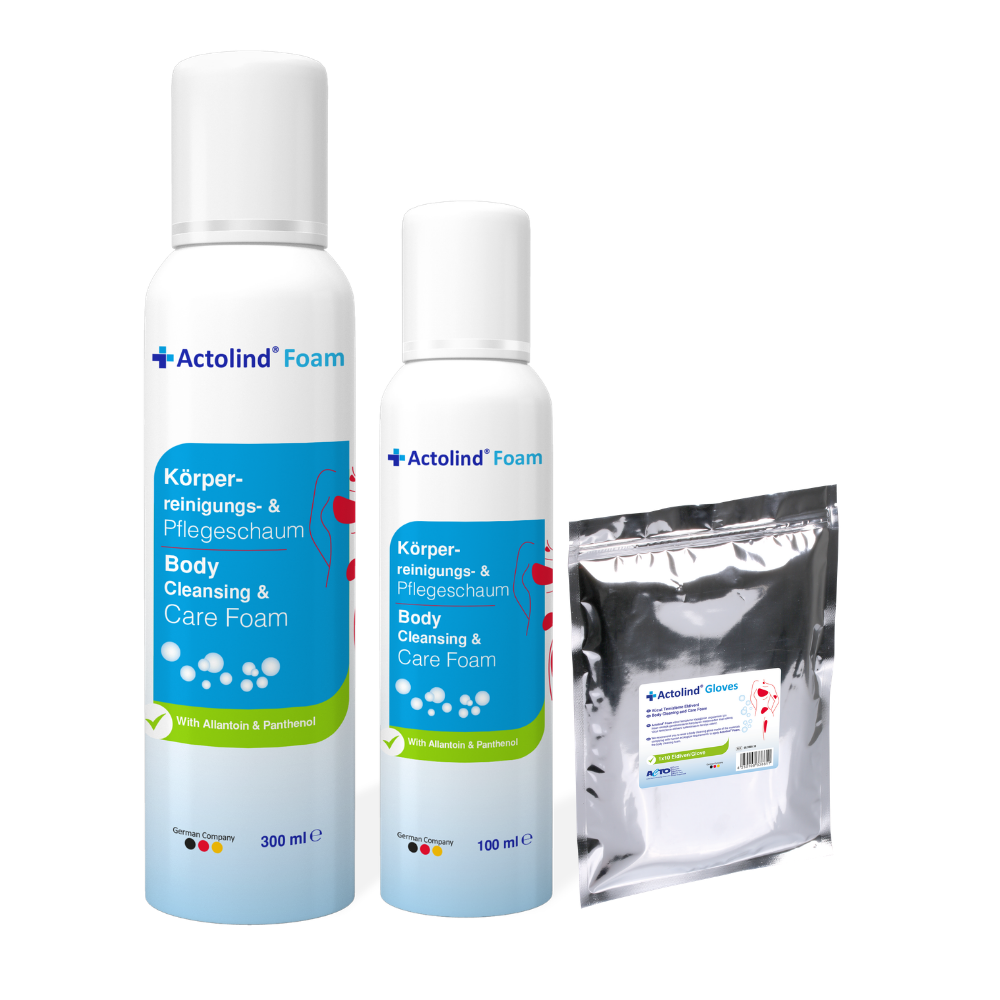
In addition to wound cleansing, it can be used for hygiene of the patient’s dressing areas (Actolind Foam is also available for general body cleansing).
Can it be used to eliminate surgical or wound suture scars?
No. This product is not an aesthetic cream or toner intended to remove scars on closed skin; it is a medical irrigation solution designed to promote infection-free closure of open wounds.
Can it be used as a cosmetic toner for facial acne or blemishes?
No. It is a Class III medically approved wound irrigation product and is not designed for aesthetic facial blemishes or use as a toner.
What is the cost advantage of Actolind Solution Plus for healthcare institutions and hospitals?
By promoting faster wound closure, it reduces the frequency of dressing changes, the use of additional consumable materials, infection treatment costs, and the length of hospital stay.
What does the approach “The real cost in wound care is not the product...” mean?
The real cost is not the unit price of the product, but rather the non-healing wound, prolonged treatment duration, resulting complications, and recurring dressing costs. Actolind Solution Plus reduces the total cost by shortening this process.
No results found for this search.