'/%3E%3C/svg%3E)

'/%3E%3Cpath%20fill='%23b2b2b2'%20d='M241%20382q0%2016%2017%2026%2017%2011%2042%2011t42-11q16-11%2017-26V269H241'/%3E%3Cpath%20fill='%239f7e00'%20d='M241%20379q0%2014%208%2023%209%209%2021%209%2014%200%2021-9%209-9%209-23V269h-59'/%3E%3Cpath%20d='M241%20339v-70h59v110q0%2014-9%2023l-6%205v-68h-15v72q-8%200-14-4v-68zm59%2040c0%2022%2015%2032%2029%2032%2021%200%2030-18%2030-32v-40h-59'/%3E%3Cpath%20fill='%239f7e00'%20d='M266%20277v5h2v12h-3v-5h2v-5h-9v5h2v5h-4v9h3v18h-5v10h34v-10h-5v-18h3v-9h-4v-5h2v-5h-9v5h2v5h-3v-12h2v-5zm42%20101q0%2010%206%2017%206%206%2015%207%2010-1%2016-7%206-7%206-17v-29h-43'/%3E%3Ccircle%20fill='%230044ad'%20cx='329.5'%20cy='372'%20r='6'/%3E%3Cellipse%20fill='%230044ad'%20cx='300'%20cy='340'%20rx='16'%20ry='21'/%3E%3C/svg%3E)


'/%3E%3C/g%3E%3Cuse%20href='%23c'%20transform='matrix(-1%200%200%201%20720%200)'/%3E%3C/svg%3E)






❮
❯


ACTOLIND® W SOLUTION
ACTOLIND® w Solution is an antimicrobial solution containing polyhexanide (PHMB) and poloxamer that supports wound cleansing and care. While helping to control microorganisms and biofilm on the wound surface, it provides gentle cleansing of the tissue. It may be used for the cleansing and moisturization of acute and chronic wounds, burns, and many types of wounds, and to support the wound care process.
- Helps remove dirt, debris, and microorganisms from the wound surface through poloxamer.
- Helps reduce microorganisms through polyhexanide (PHMB).
- Helps keep the wound surface moist, supporting a suitable wound care environment.
- Supports the care process by acting gently on wound tissue.
- Helps soften dried and adhered dressing materials.
- Supports the gentle removal of dressings without causing secondary trauma.
- Supports the control of biofilm formation and microbial load.
- Helps maintain a suitable wound care environment that supports the granulation and epithelialization processes.
- Supports moist wound care conditions. Provides wound care support suitable for long-term use.
- Compatible with modern wound dressings.

ACTOLIND W SOLUTION - 1 l
 actomarkt.com
ACTOLIND® w Solution: Professional Wound Cleansing, Irrigation, Moisturization and Care
ACTOLIND® w Solution is a ready-to-use wound care solution developed for the cleansing, irrigation, moisturization and care of acute, chronic and infected wounds, as well as first- and second-degree burns. It effectively cleanses the wound surface and helps reduce the microbial load, while also supporting the preparation of the wound surface before dressing by enabling use with bandages, dressings, pads and wound-filling materials.
Gentle Cleansing, Antimicrobial Action and Powerful Formula
Its formula helps mechanically cleanse wounds and soften dried, contaminated or wound-surface-adherent dressing materials. Poloxamer reduces surface tension to provide comfortable cleansing, while Polyhexanide (PHMB) provides antimicrobial wound care support. It provides protection against antibiotic-resistant microorganisms (such as MRSA and VRE) and mycotic pathogens, and is also well tolerated by allergy sufferers and people with diabetes.
Supports a Moist Wound Environment
ACTOLIND® w Solution helps maintain an appropriate moisture balance on the wound surface, thereby supporting the maintenance of a moist wound environment. This suitably moist environment contributes to protecting the wound bed and supporting the natural healing process.
For professional wound care use. Use only as directed by a healthcare professional. Do not use in cases of known or suspected sensitivity to any ingredient. Do not use on hyaline cartilage, in aseptic joint surgery, in the middle or inner ear, on the eye, central nervous system or meninges. Do not use together with anionic surfactants, cleansing soaps, creams, oils or enzymes; these substances must be completely removed from the wound surface before application. Do not use for peritoneal lavage. During pregnancy, breastfeeding, or in newborns or infants, use only following medical evaluation and under close supervision. Do not reuse single-use materials. Close the bottle immediately after use and protect the bottle opening from contamination. Discontinue use and consult a healthcare professional if irritation, intolerance or an unexpected reaction occurs.
| Ref. No | Variant | Barcode / GTIN | PZN | Qty/Box |
|---|---|---|---|---|
| 06.6703.05M25 | 25*5 mL | 4250108367079 | - | 1 |
| 06.6703.05 | 5x5 mL | 4250108306795 | - | 1 |
[contact-form-7 id="GLOBAL_FORM_ID" title="Contact form EN"]
Frequently Asked Questions About Actolind® Wound Care
Find clear answers about Actolind® wound care products, their intended support areas, application logic and product differences.
What is Actolind® W Solution?
Actolind® W Solution is a wound care solution used to provide cleansing, irrigation, and antimicrobial care support in wound management. Its formulation contains Polyhexanide (PHMB) and Poloxamer. Poloxamer helps the solution spread across the wound surface and facilitates the removal of materials such as exudate, debris, dried residues, and biofilm from the wound, while PHMB provides antimicrobial care support. Therefore, Actolind® W Solution should not be regarded merely as “a solution that irrigates the wound.” It can be used as part of wound care to support wound bed cleansing and microbial control.
What is Actolind® W Solution used for?
The primary purpose of Actolind® W Solution is to cleanse the wound and support wound care. Over time, exudate, blood residues, crusts, debris, necrotic tissue residues, or biofilm may be present on the wound surface. Removing these materials facilitates wound bed assessment and wound care. Actolind® W Solution also provides antimicrobial care support through its PHMB content. In current wound care practice, therapeutic wound cleansing is considered an important component of wound management.
What does Actolind® W Solution contain?
The key components of Actolind® W Solution are Polyhexanide (PHMB) and Poloxamer. PHMB contributes to the product’s antimicrobial properties, while Poloxamer, through its surfactant properties, helps wet the wound surface and supports the cleansing process. The combination of these two components enables the product to provide both cleansing and antimicrobial care support in a single application.
Why are PHMB and Poloxamer used together in Actolind® W Solution?
These two components support two different needs of the product. Poloxamer: Helps cleanse and wet the wound surface. PHMB: Provides antimicrobial care support. Therefore, Actolind® W Solution provides a wound care approach that supports not only physical cleansing but also microbial control.
Is Actolind® W Solution an antiseptic?
In product communications, it is more appropriate to describe Actolind® W Solution as an antimicrobial wound care solution. Due to its PHMB content, it has antimicrobial activity. However, rather than describing the product’s intended use solely as an “antiseptic,” defining it in terms of wound cleansing, irrigation, and antimicrobial care support more accurately reflects its intended use.
Why is it important to cleanse wounds with Actolind® W Solution?
Exudate, blood, debris, crusts, necrotic material, and structures formed by microorganisms may accumulate on the wound surface. These may make wound bed assessment and wound care more difficult. Current wound care consensus recommendations support therapeutic cleansing of the wound bed and surrounding area during dressing changes. At this cleansing stage, Actolind® W Solution helps remove residues from the wound surface, while PHMB provides antimicrobial care support.
Is Actolind® W Solution used only on infected wounds?
No. The product can be used in the care of both infected and non-infected acute and chronic wounds. Therefore, a wound does not necessarily need to be infected for Actolind® W Solution to be used. The important point is that the product is not intended to replace the overall treatment of the wound, but rather to support wound cleansing and antimicrobial care.
Does Actolind® W Solution treat infection?
Actolind® W Solution provides antimicrobial care support and helps control microorganisms through its PHMB content. However, particularly in cases of clinical infection, Actolind® W Solution should not be considered a stand-alone treatment for infection. For example, in diabetic foot infections, clinical assessment and, when necessary, systemic antibiotic therapy may be required. The appropriate medical evaluation should be performed and the wound should be assessed.
Can Actolind® W Solution be used on wounds with biofilm?
Yes. Biofilm is one of the major factors that can complicate wound care, particularly in chronic wounds with prolonged healing. The cleansing properties of Actolind® W Solution support the removal of biofilm and other residues from the wound surface. The Poloxamer in the formulation also contributes to this cleansing process through its surfactant properties. The 2025 IWII consensus also considers wound cleansing an important component of biofilm and microbial load management.
Can Actolind® W Solution be used on wounds with necrotic tissue?
Yes. Actolind® W Solution helps remove necrotic tissue residues, debris, and exudate from the wound surface. However, professional debridement may be required for wounds containing extensive or deep necrotic tissue. Therefore, the product should not be regarded as a substitute for debridement, but rather as a solution that supports wound cleansing and wound care.
Can Actolind® W Solution be used on exudative wounds?
Yes. In exudative wounds, regular removal of wound fluid, debris, and other residues that accumulate on the wound surface is an important part of wound care. Actolind® W Solution helps cleanse the wound surface. However, in wounds with heavy exudate, a cleansing solution alone may not be sufficient; a wound dressing appropriate for the level of exudate should also be selected.
Can Actolind® W Solution be used on dry and crusted wounds?
Yes. On dry wound surfaces or wounds with dried exudate, the solution may help moisten the area and soften dried residues. This property may also facilitate use, particularly in cases where dressing material has adhered to the wound surface.
Can Actolind® W Solution help remove an adherent dressing?
Yes. When a dressing dries and adheres to the wound surface, pulling it off directly may cause trauma and discomfort to the wound surface. Moistening the dressing material with Actolind® W Solution may help soften the dried material and facilitate easier removal of the dressing. Therefore, it can also be used during dressing changes.
Can Actolind® W Solution be used during dressing changes?
Yes. Cleansing the wound surface during dressing changes is an important step before applying a new dressing. Cleansing the wound surface with Actolind® W Solution can support the removal of exudate, debris, and other residues. An appropriate wound dressing can then be applied according to the condition of the wound. The 2025 IWII consensus also recommends therapeutic cleansing of the wound bed, wound margins, and periwound skin during dressing changes or dressing removal.
Does Actolind® W Solution cause a burning sensation in the wound?
No. Actolind® W Solution is not a product developed to produce a burning sensation when applied to a wound. It is a tissue-friendly solution compatible with wounds and developed for use in wound care. While the Polyhexanide (PHMB) in Actolind® W Solution provides antimicrobial care support, Poloxamer helps cleanse the wound surface. The formulation is intended not to irritate or burn the wound, but rather to gently cleanse the wound bed and support wound care. Therefore, a burning sensation is not expected during application, and the product is intended to provide comfortable use, particularly in wound care. Note: A brief stinging sensation may occur in highly sensitive, open, or traumatized tissues. However, pronounced or persistent burning, pain, or irritation should not be considered normal, and a healthcare professional should be consulted.
Can Actolind® W Solution be used for daily wound care?
Yes. Depending on the condition of the wound and the wound care plan, it can be used as part of daily wound care. Particularly in wounds requiring regular dressing changes, appropriate cleansing of the wound surface at each dressing change is important. Actolind® W Solution can be used at this stage. However, the same frequency of use is not appropriate for every wound. The frequency of use should be determined according to the type of wound, amount of exudate, risk of infection, and the dressing protocol being used.
How many times a day should Actolind® W Solution be used?
A single fixed frequency of use is not appropriate for all wounds. For some wounds, it may be used during dressing changes, while for others, it may be used as part of a more frequent wound care protocol as recommended by a healthcare professional. Therefore, rather than a fixed recommendation such as “X times a day for every wound,” it is more appropriate to use the product according to the condition of the wound and the professional wound care plan.
Should the wound be rinsed after using Actolind® W Solution?
No. The wound does not need to be rinsed after Actolind® W Solution has been applied. The product is used to support wound cleansing and care without requiring subsequent rinsing.
Can Actolind® W Solution be used instead of normal saline for wound cleansing?
Yes. Actolind® W Solution can be used instead of normal saline for wound cleansing. However, the properties of the two products are not the same. Normal saline is primarily a solution used for mechanical wound cleansing and irrigation, whereas Actolind® W Solution provides antimicrobial care support in addition to wound cleansing and irrigation. The PHMB (Polyhexanide) in its formulation provides antimicrobial activity to support microbial control, while Poloxamer supports cleansing of the wound surface and removal of unwanted residues. Therefore, Actolind® W Solution not only physically cleanses the wound but combines cleansing + irrigation + antimicrobial care support in a single application. Particularly when antimicrobial care support is desired in addition to cleansing during wound care, Actolind® W Solution may be considered a preferred option. Normal saline, on the other hand, may be used for basic irrigation and mechanical cleansing. In summary: Normal saline → basic cleansing and irrigationrnActolind® W Solution → cleansing + irrigation + antimicrobial care support
Can Actolind® W Solution be used on open wounds?
Yes. Actolind® W Solution can be used in the care of acute and chronic open wounds. It helps cleanse the wound surface in open wounds such as cuts, abrasions, surgical wounds, ulcers, and wounds caused by various other factors. The depth of the wound or the underlying cause does not eliminate the need for professional assessment.
Can Actolind® W Solution be used on cuts?
Yes. For cuts occurring in daily life, it is important to cleanse the wound surface, remove foreign material, and protect the wound appropriately. Actolind® W Solution can be used for wound cleansing. It may support routine wound care for small and superficial cuts. If the cut is deep, bleeding does not stop, the wound edges are separated, or a foreign body is present, it should be evaluated at a healthcare facility.
Can Actolind® W Solution be used on postoperative wounds?
Yes. Actolind® W Solution can be used in the care of surgical wounds following an operation. In surgical wound care, appropriate cleansing of the wound surface, protection of the wound area from external factors, and regular continuation of the wound care process are important. The PHMB (Polyhexanide) in Actolind® W Solution provides antimicrobial care support, while its Poloxamer content helps cleanse the wound surface and remove exudate, debris, and other residues. Therefore, it can be used after surgery to support wound care during wound cleansing and dressing changes. In particular, its ability to gently cleanse the wound surface during dressing changes and the fact that it does not require rinsing after application are practical features in surgical wound care. In summary: It should be used according to the recommendation and approval of the physician or relevant healthcare professional. Actolind® W Solution can be used on postoperative surgical wounds to provide wound cleansing and antimicrobial care support. However, the type of surgery, condition of the wound, and the care protocol implemented by the surgical team should also be taken into consideration. A healthcare professional should be consulted if wound dehiscence, increasing redness or swelling, significant pain, foul-smelling/purulent discharge, or fever develops.
Can Actolind® W Solution be used on diabetic foot wounds?
Yes. Diabetic foot wounds are among the indications for Actolind® W Solution. Wound cleansing is important in diabetic foot wounds; however, treatment is not limited to wound cleansing alone. Factors such as wound depth, circulation, neuropathy, infection, and pressure on the affected foot must also be assessed.
Can Actolind® W Solution be used on venous leg ulcers?
Yes. Venous ulcers are classified as chronic wounds, and Actolind® W Solution can be used in the care of these wounds. The solution helps cleanse the wound surface and remove exudate and associated residues. However, the underlying circulatory problem in venous ulcers is also an important part of treatment. Therefore, use of the product should be considered together with appropriate medical assessment and a wound care plan established by a specialist physician.
Can Actolind® W Solution be used on pressure ulcers?
Yes. In pressure ulcers, keeping the wound surface clean and managing exudate are important. Actolind® W Solution can be used during this stage of wound care. However, wound cleansing alone is not sufficient for the management of pressure ulcers. Other care measures, such as pressure relief, appropriate positioning, nutritional support, and wound dressings suitable for the stage of the wound, are also important.
Can Actolind® W Solution be used on burns?
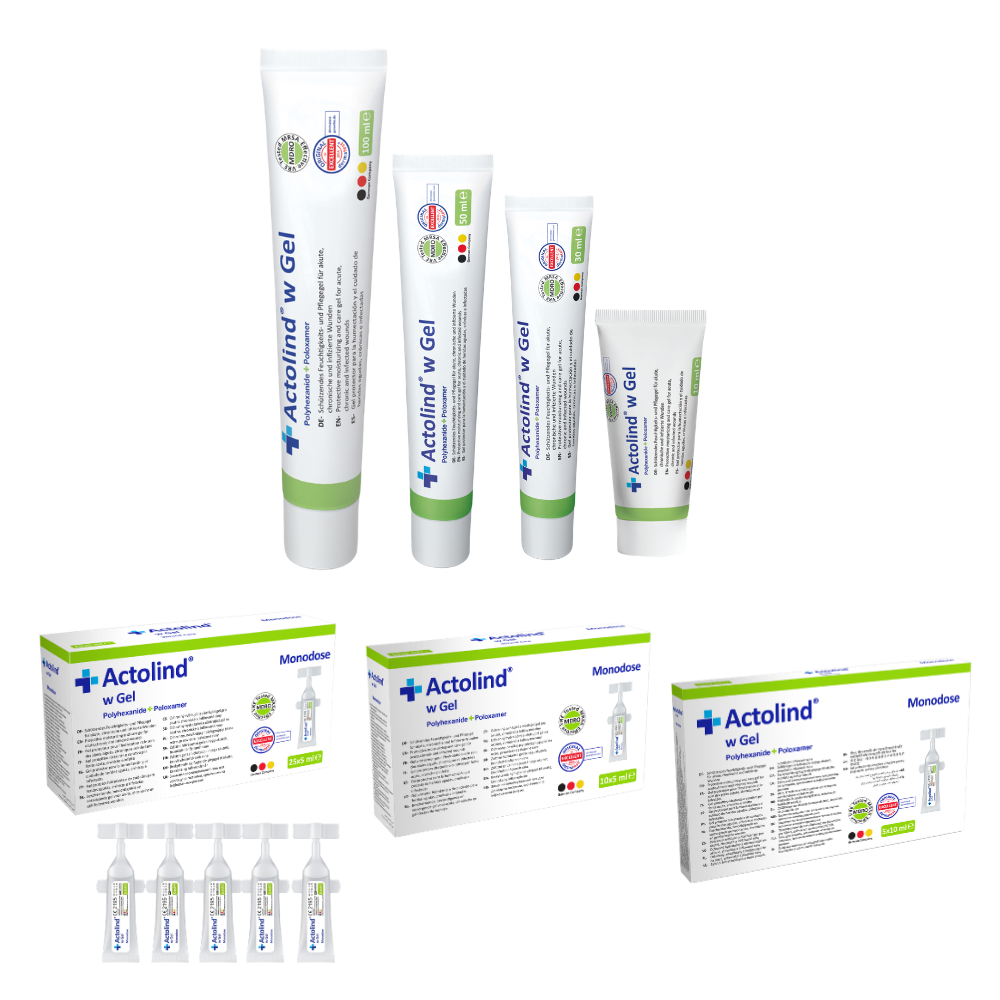
Yes. Actolind® W Solution can be used in the wound care of burns. Its intended uses include thermal and chemical burns, as well as wounds and burns caused by electrical and radiation injuries. In burn care, appropriate cleansing of the wound surface, protection of the wound bed, and support of the healing process are important. The Poloxamer in Actolind® W Solution helps cleanse the wound surface and remove unwanted residues such as exudate and debris, while its PHMB (Polyhexanide) content provides antimicrobial care support. Actolind® W Solution and Actolind® W Gel can be used together in burn care. After cleansing and irrigating the wound surface with the Solution, application of the Gel to the wound bed provides a complementary wound care approach by combining cleansing, antimicrobial care, and maintenance of a moist wound environment.
Can Actolind® W Solution be used on electrical burns?
Yes. Actolind® W Solution can be used in the care of electrical burns and wounds caused by electrical injuries. Electrical wounds and burns are included among the product’s intended uses. In electrical burns, visible skin damage may not always reflect the extent of deeper tissue injury caused by the electrical current. Therefore, medical assessment should be performed first. When considered appropriate, Actolind® W Solution can be used for wound surface cleansing and irrigation. The Poloxamer in its formulation helps remove exudate, debris, and other unwanted residues from the wound surface, while PHMB (Polyhexanide) provides antimicrobial care support. Actolind® W Solution and Actolind® W Gel can be used together in a complementary manner in the care of electrical burns. The wound surface is first cleansed and irrigated with the Solution. When appropriate, Actolind® W Gel can then be applied to the cleansed wound bed to help maintain a moist environment and support ongoing wound care.
Can Actolind® W Solution be used on radiation-induced wounds?
Yes. Radiation-induced wounds and burns are listed among the intended uses of the product. Because these wounds require specific assessment of the condition of the skin and underlying tissues, use of the product should be considered within a wound care plan recommended by a healthcare professional.
Can Actolind® W Solution be used on chemical burns?
Yes. Chemical burns are among the intended uses of Actolind® W Solution. However, in chemical burns, the first and most important step is to safely terminate exposure and provide appropriate first aid and medical assessment. Actolind® W Solution does not replace this emergency management; it may be used for wound care at an appropriate stage.
Can Actolind® W Solution be used on wounds caused by bites and insect stings?
Yes. Traumatic wounds resulting from bites and stings are among the intended uses of the product. Cleansing the wound surface is important in these types of wounds. However, particularly in animal or human bites, additional medical assessment may be required regarding infection, tetanus, and, in certain cases, rabies. Actolind® W Solution can support wound cleansing and care but should not replace medical assessment when such evaluation is required.
Can Actolind® W Solution be used on wounds caused by an ingrown toenail?
Yes. Actolind® W Solution can be used to cleanse and care for wounds and irritated areas caused by an ingrown toenail. An ingrown toenail may cause an open wound, tenderness, redness, discharge, or irritation around the nail margin. In such cases, appropriate wound cleansing and removal of dirt, exudate, and other unwanted residues from the wound surface are important. The Poloxamer in Actolind® W Solution helps cleanse the wound surface and remove exudate and other residues, while PHMB (Polyhexanide), through its antimicrobial activity, supports microbial control as part of wound care. Therefore, the product helps not only with physical cleansing of the wound caused by an ingrown toenail but also provides antimicrobial care support. For ongoing care of wounds caused by an ingrown toenail, combined use with Actolind® W Gel may also be preferred when appropriate. In this approach: Actolind® W Solution → cleanses the wound surface and provides antimicrobial care support. Actolind® W Gel → helps maintain a moist environment in the cleansed wound bed and supports ongoing wound care. Therefore, the Solution and Gel can be used as complementary products in the care of wounds caused by an ingrown toenail.
Can Actolind® W Solution be used around a stoma?
Yes. Actolind® W Solution can be used for stoma and peristomal skin care. The skin surrounding a stoma may become sensitive, irritated, or compromised due to contact with stool or urine, moisture, leakage, and repeated use of adhesive materials from stoma appliances. Actolind® W Solution can be used in this area to provide cleansing and antimicrobial care support. The Poloxamer in its formulation helps remove unwanted residues and exudate from the peristomal area, while PHMB (Polyhexanide), through its antimicrobial activity, supports microbial control. When appropriate, Actolind® W Solution and Actolind® W Gel can be used together in the care of wounds or irritation around the stoma. In this combined approach, the products complement each other: Actolind® W Solution → helps cleanse the area and provides antimicrobial care support. Actolind® W Gel → helps maintain a moist environment in the cleansed and sensitized area and supports ongoing wound care. Therefore, when there is a wound, irritation, or compromised skin integrity around the stoma, cleansing with the Solution may be followed, when appropriate, by complementary care with the Gel. In summary: Around the stoma, Actolind® W Solution can be used for cleansing and antimicrobial care support, while Actolind® W Gel can be used to support wound care and maintenance of a moist environment in the cleansed area. If redness or irritation around the stoma persists or recurs, particularly in the presence of leakage, pain, bleeding, foul-smelling discharge, or significant skin damage, assessment by a stoma care nurse or healthcare professional is important rather than relying solely on a topical wound care product.
Can Actolind® W Solution be used around a fistula?
Yes. Fistula care is listed among the intended uses of the product. The skin surrounding a fistula may become irritated due to continuous exposure to fluid. Therefore, appropriate cleansing of the area and protection of the periwound skin are important. Actolind® W Solution can be used during the cleansing stage. Treatment of the fistula itself should be planned separately according to its underlying cause.
Can Actolind® W Solution be used on abscesses?
Yes. Abscesses are included among the intended uses of the product. When appropriate, Actolind® W Solution can help cleanse and care for the wound surface. However, an abscess is often not a condition that can be managed solely by cleansing the external surface. As abscess drainage, antibiotic therapy, or other medical interventions may be required, assessment by a healthcare professional is important.
Can Actolind® W Solution be used on cavity wounds?
Yes. Actolind® W Solution can be used for wound cleansing and irrigation in cavity wounds. Particularly when exudate, debris, and other unwanted residues accumulate beneath the wound surface or within the cavity, appropriate cleansing of accessible areas of the wound is an important part of wound care. The Poloxamer in Actolind® W Solution helps wet the wound surface and remove residues such as exudate and debris, while PHMB (Polyhexanide) provides antimicrobial care support. This helps cleanse not only the visible portion of a cavity wound but also the accessible internal surfaces of the cavity, while supporting microbial control. Actolind® W Solution and Actolind® W Gel may also be used in combination for cavity wounds. As part of appropriate wound care, the wound and cavity are first cleansed/irrigated with the Solution. Then, when appropriate for the condition of the wound, Actolind® W Gel can be applied to the cleansed wound bed to help maintain a moist environment and support ongoing wound care. In summary: Actolind® W Solution → cavity cleansing + irrigation + antimicrobial care supportrnActolind® W Gel → maintenance of a moist environment in the cleansed wound bed + complementary wound carernSolution + Gel → support different stages of cavity wound care in a complementary mannerrnrnParticularly in deep, narrow, tunneled, or anatomically sensitive cavity wounds, the method of application should be determined according to the depth and structure of the wound. Therefore, professional wound assessment and an appropriate application technique are important for deep cavity wounds.
an Actolind® W Solution be used before grafting?
Yes. Wound bed cleansing and appropriate preparation are important stages of graft application. In accordance with its intended use, Actolind® W Solution can help cleanse the wound bed. However, preparation of the wound for grafting and selection of the products to be used should follow the protocol established by the surgeon or wound care team.
Can Actolind® W Solution be used for wound care in children?
Actolind® W Solution can be used for wound care in children. It should be used according to the recommendation and approval of a physician or relevant healthcare professional. When appropriate for the condition of the wound, Actolind® W Gel may be used together with the Solution to support different stages of the wound care process by helping cleanse the wound surface and providing antimicrobial care support.
Why should I choose Actolind® W Solution?
The key feature of Actolind® W Solution is that it combines wound cleansing and antimicrobial care support in a single product. The Poloxamer in its formulation helps wet the wound surface and remove materials such as exudate, debris, dried residues, and biofilm, while PHMB provides antimicrobial care support aimed at microbial control. Therefore, Actolind® W Solution can be used to support wound cleansing and care across the product’s indicated areas of use, ranging from minor traumatic and chronic wounds to burns, diabetic ulcers, stoma and fistula care, and catheter insertion sites. In summary, Actolind® W Solution is a wound care solution that addresses one of the first and most important steps in wound management—cleansing—while also providing antimicrobial care support.
Why can Actolind® W Solution be preferred as an alternative to hypochlorous acid-containing solutions?
Actolind® W Solution, through its combination of 0.1% PHMB and Poloxamer, not only provides antimicrobial care support but also supports wound surface cleansing and the removal of exudate, debris, and biofilm layers. Its high tissue compatibility, its non-inhibitory effect on granulation and epithelialization, and its suitability for long-term wound care make Actolind® W Solution an option that may be preferred particularly in the care of acute and chronic wounds.
Can Actolind® W Solution be used for wound care in patients receiving chemotherapy?
Yes. Actolind® W Solution can be used for the care of appropriate wounds and skin damage in patients receiving chemotherapy. Chemotherapy may affect skin integrity and wound healing. Therefore, appropriate cleansing of any resulting wounds and regular continuation of wound care are important. The Poloxamer in Actolind® W Solution helps cleanse the wound surface and remove exudate and unwanted residues, while PHMB (Polyhexanide) provides antimicrobial care support. When appropriate for the condition of the wound, it may also be used in combination with Actolind® W Gel. While the Solution provides cleansing and antimicrobial care support, the Gel helps maintain a moist environment in the cleansed wound bed and supports ongoing wound care. In patients receiving chemotherapy, wound care should be carried out in accordance with the recommendations of the healthcare professional managing the patient’s treatment.
What is Actolind® W Solution used for in radiotherapy-related skin damage?
Actolind® W Solution can be used for wound cleansing, irrigation, and antimicrobial care support when skin integrity is compromised and a wound develops following radiotherapy. The Poloxamer in its formulation helps cleanse the wound surface, while PHMB provides antimicrobial care support. As wound care continues, Actolind® W Gel may be used in combination when appropriate to help maintain a moist environment in the cleansed wound bed. For radiotherapy-related skin reactions, the care protocol recommended by the oncology team should take priority.
Can Actolind® W Solution be used on tumor-related wounds?
Yes. Actolind® W Solution can be used for appropriate local wound care in tumor-related wounds. In these types of wounds, cleansing the wound surface, managing exudate, and controlling the microbial load are important components of wound care. Actolind® W Solution provides cleansing, irrigation, and antimicrobial care support. When appropriate, it may be combined with Actolind® W Gel to help maintain a moist environment in the wound bed. However, the primary treatment for tumor-related wounds is the patient’s oncological treatment and the wound care plan established by the healthcare professional.
Can Actolind® W Solution be used for long-term wound care in oncology patients?
For appropriate wounds, Actolind® W Solution can be used as part of long-term wound care. The product information indicates its tissue compatibility and suitability for long-term wound care. In chronic and non-healing oncological wounds, the progression of the wound should be regularly assessed by a healthcare professional.
Can Actolind® W Solution be used for wound care in infants?
It can be used for appropriate wound care in children; however, use in infants should be evaluated according to the infant’s age and the characteristics of the wound. Actolind® W Solution provides wound cleansing and antimicrobial care support. However, because infant skin differs from adult skin, assessment by a healthcare professional is important for extensive, deep, or serious wounds.
Can Actolind® W Solution be used on abrasions and wounds caused by falls in children?
Yes. It can be used to cleanse appropriate superficial abrasions caused by falls or friction in children. The Solution helps cleanse the wound surface and provides antimicrobial care support through its PHMB content. If the wound is open and appropriate for further care, Actolind® W Gel may be applied after cleansing as complementary wound care.
Can Actolind® W Solution be used around fistulas?
Yes. Fistula care is listed among the product’s areas of use. The skin surrounding a fistula may become irritated due to continuous exposure to fluid. Therefore, appropriate cleansing of the area and protection of the periwound skin are important. Actolind® W Solution can be used during the cleansing stage. Treatment of the fistula itself should be planned separately according to its underlying cause.
Can Actolind® W Solution be used on burns in children?
It can be used for wound care in appropriate burns. The Solution provides wound cleansing and antimicrobial care support. Depending on the condition of the wound, combined use with Actolind® W Gel may also be considered. Extensive or deep burns, as well as burns involving the face, hands, genital area, or joints, should always be evaluated by a healthcare professional.
Is Actolind® W Solution suitable for children’s sensitive skin?
Actolind® W Solution is designed for wound care, with tissue compatibility being an important characteristic of the formulation. However, it would not be appropriate to generalize that it “can be used on all types of sensitive skin in children.” The product is primarily intended for use on wounds and in wound care.
How should the use of Actolind® W Solution in newborns be evaluated?
For use in newborns, the product-specific instructions for use and the assessment of a healthcare professional should be taken into consideration. Because the skin barrier of newborns is particularly sensitive, the use of the product, especially on extensive or deep wounds, should be evaluated by a physician.
What should be considered when using Actolind® W Solution in pediatric patients?
The product’s instructions for use should be followed, and the size, depth, and condition of the wound should be taken into consideration. Extensive, deep, infected, severe burn, or non-healing wounds should be evaluated by a healthcare professional.
No results found for this search.