'/%3E%3C/svg%3E)

'/%3E%3Cpath%20fill='%23b2b2b2'%20d='M241%20382q0%2016%2017%2026%2017%2011%2042%2011t42-11q16-11%2017-26V269H241'/%3E%3Cpath%20fill='%239f7e00'%20d='M241%20379q0%2014%208%2023%209%209%2021%209%2014%200%2021-9%209-9%209-23V269h-59'/%3E%3Cpath%20d='M241%20339v-70h59v110q0%2014-9%2023l-6%205v-68h-15v72q-8%200-14-4v-68zm59%2040c0%2022%2015%2032%2029%2032%2021%200%2030-18%2030-32v-40h-59'/%3E%3Cpath%20fill='%239f7e00'%20d='M266%20277v5h2v12h-3v-5h2v-5h-9v5h2v5h-4v9h3v18h-5v10h34v-10h-5v-18h3v-9h-4v-5h2v-5h-9v5h2v5h-3v-12h2v-5zm42%20101q0%2010%206%2017%206%206%2015%207%2010-1%2016-7%206-7%206-17v-29h-43'/%3E%3Ccircle%20fill='%230044ad'%20cx='329.5'%20cy='372'%20r='6'/%3E%3Cellipse%20fill='%230044ad'%20cx='300'%20cy='340'%20rx='16'%20ry='21'/%3E%3C/svg%3E)


'/%3E%3C/g%3E%3Cuse%20href='%23c'%20transform='matrix(-1%200%200%201%20720%200)'/%3E%3C/svg%3E)






❮
❯


ACTOLIND® W GEL
ACTOLIND® w Gel is an antimicrobial gel containing polyhexanide (PHMB) and poloxamer, intended for wound care. It helps control the microbial load and biofilm formation on the wound surface while supporting the maintenance of a suitable moist wound environment. With its tissue-friendly formulation, it helps support the wound care process in acute and chronic wounds.
- Supports antimicrobial activity.
- Helps control biofilm formation.
- Supports the reduction of the microbial load.
- Helps keep the wound surface clean and moist.
- Supports the maintenance of a suitable moist wound environment.
- Helps create a barrier between the wound and the dressing.
- Helps protect the wound bed.
- Contributes to maintaining a suitable wound environment that supports the development of granulation and epithelialization tissue.
- Supports wound care for wounds prone to biofilm formation.
- Compatible with modern wound dressings.

ACTOLIND W GEL - 10 ml
 actomarkt.com

ACTOLIND W GEL - 30 ml
actomarkt.com

ACTOLIND W GEL - 50 ml
actomarkt.com
 amazon.de

ACTOLIND W GEL - 100 ml
actomarkt.com

ACTOLIND W GEL - 10*5 ml
actomarkt.com
ACTOLIND® w Gel: Protective Moisturizing Care for Wounds and Burns
ACTOLIND® w Gel is a protective moisturizing wound care gel developed for the care of acute, chronic, infected and non-infected wounds, as well as 1st- and 2nd-degree burns. Its gel structure helps coat the wound surface, support a moist wound environment, and create a protective interface between the wound bed and the dressing.
Protective Film Layer for Comfortable Dressing Changes
Its formulation forms a thin protective film layer on the wound surface. This structure helps reduce the adhesion of the dressing to the wound surface, fill the space between the wound and the dressing, and support easier, more comfortable dressing changes.
Combination of PHMB and Poloxamer
Containing 0.1% Polyhexanide and Poloxamer, ACTOLIND® w Gel helps maintain tissue-friendly wound care conditions while supporting antimicrobial protection, moisture balance, and the care of wound surfaces prone to biofilm formation.
For professional wound care use. Use only as directed by a healthcare professional. Do not use in case of known sensitivity to Polyhexanide, Poloxamer, or any component of the product. Do not apply excessive mechanical force during wound care. Do not reuse single-use packaging. Keep out of reach of children. Avoid contaminating the tube or monodose opening during use. During pregnancy, breastfeeding, or use in newborns or infants, it should only be used following medical evaluation and under close supervision. If irritation, intolerance, or an unexpected reaction occurs, discontinue use and consult a healthcare professional.
| Ref. No | Variant | Barcode / GTIN | PZN | Qty/Box |
|---|---|---|---|---|
| 06.6803.05M25 | 25*5 mL | 4250108368083 | - | 1 |
| 06.6803.250 | 250 mL | 4250108368106 | - | 1 |
[contact-form-7 id="GLOBAL_FORM_ID" title="Contact form EN"]
Frequently Asked Questions About Actolind® Wound Care
Find clear answers about Actolind® wound care products, their intended support areas, application logic and product differences.
Can Actolind W Gel be mixed with another medical cream, ointment, or antibiotic ointment before being applied to the wound?
No. Actolind products should not be mixed with other creams, ointments, or chemical substances before application. Actolind gels and solutions have patented formulations in which the molecular balance, biocompatibility index, and pH level (5.0–7.5) of the PHMB and Poloxamer components have been specifically optimized. Therefore, mixing the product with another cream, ointment, or chemical substance may: Disrupt its protective film-forming and moisture-retaining properties. Reduce its antimicrobial activity or eliminate it completely. Adversely affect tissue compatibility and cause irritation. For this reason, Actolind products should be applied directly and independently to the wound bed. If another cream or ointment has been prescribed by a physician, the products should not be mixed; they should be applied separately according to the sequence and intervals recommended by the physician.
Is Actolind W Gel suitable for the care or treatment of facial pimples (acne)?
Actolind W Gel has not been specifically developed for acne treatment and is not intended to directly treat acne. Acne is a multifactorial dermatological condition in which factors such as sebaceous gland activity, pore blockage, hormonal factors, and microorganisms such as Cutibacterium acnes may play a role; therefore, the appropriate treatment approach should be determined through dermatological evaluation. However, the antimicrobial activity provided by PHMB (Polyhexanide) in Actolind W Gel and its properties that support cleansing of the skin surface may be considered supportive in acne-related care. Particularly as part of acne management, supporting skin hygiene, helping control the microbial load on the skin surface, and maintaining the skin barrier may be important. Actolind W Gel may: Help keep the skin surface clean. Support the control of the microbial load on the skin through its antimicrobial properties. Provide supportive care in areas where skin integrity is compromised, irritated, or where small superficial lesions are present. However, Actolind W Gel should not be regarded as a product that treats pimples on its own or completely eliminates acne. During acne treatment, it may be used as supportive care alongside treatments recommended by a dermatologist, with the aim of supporting skin cleansing and microbial load control. The method and suitability of use should be evaluated according to the type of acne, skin sensitivity, and other treatments being used.
What is Actolind W Gel and what is its primary function?
Actolind W Gel is a wound care gel with protective, moisturizing, and antimicrobial properties, used in the care of acute and chronic wounds, infected and non-infected wounds, and first- and second-degree burns. The combination of Polyhexanide (PHMB) and Poloxamer provides versatile support for wound care. Its primary functions include: Maintaining a moist wound surface: Helps preserve the optimal moist wound environment required for healing. Forming a protective film layer: Helps protect the wound surface from external factors while creating a barrier between the wound and the dressing, reducing drying and helping prevent the dressing from adhering to the wound. Providing antimicrobial protection: The PHMB content helps control the microbial load on the wound surface and contributes to reducing the risk of recontamination. Supporting wound care: Helps manage necrotic tissue, scabs, and biofilm formation while supporting natural wound-healing processes such as granulation and epithelialization. Facilitating dressing changes: The gel forms a protective layer between the wound and the dressing, helping make dressing changes more comfortable and atraumatic. Actolind W Gel can be used as part of an appropriate wound care protocol for many wound types, including diabetic foot ulcers, venous ulcers, pressure ulcers, surgical wounds, traumatic wounds, and first- and second-degree burns. For best results, it is recommended that the wound surface first be cleansed with Actolind W Solution, followed by the application of Actolind W Gel.
What are the main active ingredients in Actolind W Gel?
The main active ingredients are Polyhexanide (PHMB, 0.1%) and Poloxamer.
What is the effect of PHMB in Actolind W Gel on the wound?
Polyhexamethylene Biguanide (PHMB, 0.1%) provides broad-spectrum antimicrobial protection, helping control the microbial load on the wound surface. It acts by binding to bacterial membranes, thereby helping reduce the microbial burden. Its high tissue compatibility also supports the wound-healing process.
What is the function of Poloxamer in Actolind W Gel?
Poloxamer 188 acts as a surfactant, helping remove dirt, exudate, necrotic tissue residues, and biofilm from the wound surface. It also helps maintain wound moisture, contributing to an optimal environment for wound healing.
How does Actolind W Gel form a layer on the wound?
When applied, Actolind W Gel forms a thin, transparent, protective gel layer on the wound surface that helps retain moisture. By helping the wound remain moist, this layer supports the maintenance of an environment suitable for wound healing. The protective gel layer: Helps prevent the wound surface from drying out. Creates a protective barrier between the wound and the dressing, reducing the risk of the dressing adhering to the wound and making dressing changes more comfortable. Helps provide a protective barrier against contamination from the external environment. Supports continued contact of PHMB with the wound surface, helping maintain its antimicrobial activity. Helps maintain an optimal moisture balance, supporting natural wound-healing processes such as granulation and epithelialization. To maintain the effectiveness of this protective layer, Actolind W Gel should be applied directly to the wound bed in a sufficient amount and should not be mixed with other creams, ointments, or chemical products. If other topical products are required, they should be applied separately according to the sequence and intervals recommended by the physician.
What is the pH value of Actolind W Gel?
The pH value of Actolind W Gel is between 5.0 and 7.5. This range has been optimized to support tissue compatibility in wound care and compatibility with the physiological wound environment. Due to its pH value close to the physiological range, the product: Demonstrates high compatibility with wound tissue. Helps maintain a suitable microenvironment that supports the natural wound-healing process. Supports the effectiveness and stability of its special formulation containing PHMB and Poloxamer. Provides a biocompatible care environment that can be used safely on sensitive wound tissue. The pH range of Actolind W Gel is an important characteristic of its patented formulation, specifically developed to contribute to maintaining favorable conditions for wound healing.
Is Actolind W Gel biologically compatible with tissue?
Yes. Its Biocompatibility Index (BI) is >1. The Biocompatibility Index (BI) is a scientific parameter that indicates the balance between the antimicrobial efficacy of a product against microorganisms and its compatibility with human cells. A BI value above 1 (>1) indicates that the product demonstrates high biocompatibility with human tissue cells while remaining effective against microorganisms. In other words, its antimicrobial efficacy is greater than its potential to damage cells. For Actolind W Gel, a BI >1 supports the following advantages: Provides high tissue compatibility and contributes to safe use on the wound surface. Provides effective antimicrobial protection while aiming to minimize the risk of damage to healthy tissue. Helps support natural wound-healing processes such as granulation and epithelialization. Provides a well-tolerated product profile for long-term wound care. In summary, a BI >1 is an important indicator demonstrating that Actolind W Gel combines effective antimicrobial protection with tissue-friendly properties in wound care.
Does Actolind W Gel have a biocompatibility certification?
Yes. Actolind W Gel has been evaluated for biocompatibility within the scope of the relevant medical device standards and has successfully passed the required biocompatibility tests. The product’s biocompatibility is supported by testing conducted in accordance with the ISO 10993 biological evaluation standards. These evaluations are intended to verify the product’s safety and tissue tolerance when it comes into contact with wound tissue.
Is Actolind W Gel absorbed into the bloodstream?
Due to the large polymeric structures of its active ingredients, the risk of cellular absorption and entry into the systemic circulation is considered negligible. Actolind W Gel is a wound care gel developed for topical (external) use, and under appropriate conditions of use, systemic absorption or entry into the bloodstream is not expected. The product’s antimicrobial component, Polyhexanide (PHMB), is formulated to exert a local effect on the wound surface. Actolind W Gel forms a protective and moisturizing gel layer over the wound surface, allowing its antimicrobial activity to remain localized to the application area and is not designed for systemic action.
Does Actolind W Gel pose a carcinogenic risk?
No. Polyhexanide (PHMB), contained in Actolind W Gel, is a substance that has been assessed within the scope of safety evaluations. In assessments conducted by CARC (Cancer Assessment Review Committee), Polyhexanide has been classified among substances considered “not likely to be carcinogenic to humans” through dermal exposure. The short- and long-term health effects of Polyhexanide have been evaluated, and available assessments have not identified evidence indicating a carcinogenic, toxic, or genotoxic risk to human health. Actolind W Gel is intended for local wound care, and its PHMB content is designed to provide antimicrobial protection on the wound surface. The product’s biocompatibility characteristics and safety profile have also been evaluated for compatibility with wound tissue. Therefore, based on the available safety data, there is no scientific evidence indicating a carcinogenic risk when Actolind W Gel is used according to its instructions for use.
What types of acute wounds can Actolind W Gel be used for?
Actolind W Gel is a wound care gel used in the management of acute wounds to support the normal healing process, maintain moisture balance on the wound surface, and help control the microbial load. It can be used for various types of acute wounds, including sudden traumatic wounds, surgical wounds, and burns. The main types of acute wounds for which Actolind W Gel can be used include: Surgical wounds: It can be used in the care of postoperative incision sites, sutured or non-sutured surgical incisions, and wound areas following surgical procedures. Cuts (lacerations): It can be used in the care of superficial and deep skin cuts caused by glass, knives, or other sharp objects. Abrasions: It supports the care of abrasions in which the upper layers of the skin have been damaged due to falls, friction, or accidents. Tear wounds: It can support wound care in irregular tears involving the skin and underlying tissues caused by trauma. Puncture wounds: It can be used as part of appropriate wound management in disruptions of skin integrity caused by nails, thorns, or similar objects. Traumatic wounds: It supports wound care in acute tissue injuries resulting from accidents, falls, impacts, or sports injuries. Crush and compression injuries: It can be used for skin and soft-tissue injuries caused by impact or pressure. First- and second-degree burns: It helps maintain moisture on the wound surface and preserve an environment suitable for healing in superficial burns caused by heat, hot liquids, steam, chemicals, or similar agents. Skin graft donor and recipient sites: It can be used as supportive care for wound areas resulting from skin graft procedures. Wound areas following drainage, catheterization, or minor surgical procedures: It may be used as part of an appropriate wound care protocol to help protect the wound surface. Actolind W Gel forms a protective, moisture-retaining gel layer on the wound surface, helping prevent the wound from drying out, facilitating dressing changes, and maintaining an environment suitable for wound healing. Particularly in acute wounds at risk of contamination or infection, the PHMB (Polyhexanide) content helps control the microbial load. Before use, the wound type, depth, and healing status should be assessed. Deep or severe wounds, wounds showing signs of infection, or wounds requiring specialized medical intervention should be managed according to the recommendations of a healthcare professional.
What types of chronic wounds is Actolind W Gel effective for?
Chronic wounds are wounds that do not complete the normal wound-healing process within the expected period and remain stalled in one or more phases of healing (inflammation, proliferation, or remodeling) for an extended period. In these wounds, tissue repair is delayed and may be adversely affected by factors such as impaired circulation, pressure, diabetes, infection, recurrent trauma, or underlying systemic diseases. Chronic wounds are generally considered wounds that persist for more than 4–6 weeks or fail to demonstrate a normal healing tendency. The main types of chronic wounds in which Actolind W Gel can be used include: Diabetic foot ulcers Pressure ulcers (decubitus ulcers / bedsores) Venous ulcers Arterial (ischemic) ulcers Neuropathic wounds Infected chronic wounds Chronic surgical wounds Trauma-related chronic wounds Malignancy-associated wounds (tumor wounds) Radiation-induced wounds Chronic wounds following burns Wounds associated with autoimmune diseases Wounds associated with inflammatory diseases Chronic wound areas associated with fistula and sinus formation Peristomal wounds and wounds of the surrounding skin Chronic wounds associated with osteomyelitis Chronic skin ulcers associated with pressure Wounds associated with vasculitis Wounds associated with lymphedema Chronic open wounds and tissue defects Actolind W Gel can be used in the care of many different types of chronic wounds.
Can Actolind W Gel be used in burn treatment?
Yes. Actolind W Gel can be used in the care of various types of burns, particularly first- and second-degree thermal, scald, flame, and chemical burns, whether infected or non-infected. Its formulation containing Polyhexanide (PHMB) and Poloxamer helps cleanse the wound surface, supports biofilm management, maintains a moist wound-healing environment, and supports the wound care process. It also helps reduce dressing adherence to the wound, contributing to more comfortable dressing changes. Note: Extensive, deep, or third-degree burns should always be evaluated and treated by a healthcare professional.
Can Actolind W Gel be used on electrical and radiation burns?
Yes. Actolind W Gel can be used in the care of wounds and burns caused by electrical current, as well as radiation-induced wounds and burns. Its formulation containing Polyhexanide (PHMB) and Poloxamer helps cleanse the wound surface, supports biofilm management, maintains a moist wound-healing environment, and supports the wound care process. Note: Because electrical burns and radiation injuries can cause serious tissue damage, these injuries should always be evaluated by a healthcare professional and managed as part of an appropriate treatment plan.
Can Actolind W Gel be used around catheters?
Yes. Actolind W Gel can be used in the care of urinary, central venous, peripheral venous, dialysis, PEG, and other catheter insertion sites. Its formulation containing Polyhexanide (PHMB) and Poloxamer helps cleanse the catheter insertion area, reduce biofilm and microbial load, and maintain a moist wound-healing environment. Its PHMB content helps control the existing microbial load, while appropriate and regular use contributes to maintaining hygiene around the catheter insertion site and reducing the risk of infection. It also helps reduce dressing adherence to the tissue, supporting more comfortable wound care.
Is Actolind W Gel preferred for stoma and fistula care?
Yes. Actolind W Gel can be preferred for the care of the skin and wounds surrounding stomas and fistulas. Its formulation containing Polyhexanide (PHMB) and Poloxamer helps gently cleanse the area, reduce biofilm and microbial load, maintain a moist wound-healing environment, and support skin integrity. Its PHMB content helps control the existing microbial load, while regular and appropriate use contributes to reducing the risk of infection and maintaining hygiene around the stoma and fistula. It also helps reduce dressing adherence to the tissue, making wound care more comfortable.
Is Actolind W Gel effective for wounds caused by ingrown toenails?
Yes. Open wounds caused by ingrown toenails may become susceptible to bacterial accumulation and infection. Actolind W Gel gently cleanses the wound surface and helps maintain a moist environment suitable for healing. Its PHMB content helps control the microbial load on the wound surface, while regular wound care contributes to reducing the risk of infection. It also helps reduce dressing adherence to the wound surface, making wound care more comfortable and supporting the formation of healthy granulation tissue.
Has Actolind W Gel been used in cases of Aplasia Cutis? If so, what effects were observed on the healing process?
Yes. Actolind W Gel was used in a case of Aplasia Cutis Congenita (ACC) presented in a poster at the 19th National and 7th International Wound Congress in 2025. In this case, conservative wound care was performed with Actolind Solution and Actolind Gel without surgical intervention. According to the poster results, epithelialization at the wound margins and a reduction in wound size were observed by day 18. By day 36, the necrotic tissue had completely disappeared and most of the wound had epithelialized. The study reported that conservative wound care with Actolind W Gel supported the wound-healing process and that the observed outcomes were consistent with the literature.
Can Actolind W Gel be used after graft procedures?
Yes. Actolind W Gel can be used to support wound care both in preparing the wound bed before grafting and following graft procedures. By helping cleanse the wound surface and control biofilm and microbial load, it supports the creation of a suitable wound bed for grafting. After graft application, it helps maintain a moist wound-healing environment, reduces dressing adherence to the wound surface, and, with regular use, may help reduce the risk of infection. In this way, it supports graft protection and effective wound care.
Can Actolind W Gel be used in cavity wounds?
Yes. In cavity wounds, Actolind W Gel can fill the wound space and help prevent pathogen colonization. Because these wounds may be prone to accumulation of exudate and biofilm, its formulation containing Polyhexanide (PHMB) and Poloxamer helps cleanse the wound cavity and supports the control of biofilm and microbial load. By helping maintain a moist wound-healing environment, it supports granulation tissue development and continued wound care. In cavity wounds, the product should be used together with appropriate dressing materials that adequately fill the wound cavity and according to the assessment of a healthcare professional.
What should be done before applying Actolind W Gel to a wound?
Before applying Actolind W Gel, the wound surface should be thoroughly cleansed with Actolind W Solution. The entire wound and surrounding area should be cleansed to remove contaminants, debris, and wound residues. For wounds with deep and extensive necrotic tissue, applying a compress soaked with Actolind W Solution for at least 10–15 minutes is recommended. The solution should not be diluted. After cleansing, the wound bed should be completely covered with a sufficient amount of Actolind W Gel, followed by application of an appropriate secondary dressing. Actolind W Gel helps maintain a moist environment on the wound surface and reduces dressing adherence to the wound bed. Important: Before applying Actolind W Gel, no incompatible products such as soap, cream, oil, enzymes, or anionic surfactants should remain on the wound.
Should Actolind W Gel be rinsed off after application?
No. Actolind W Gel should not be rinsed off after application. After cleansing, the wound surface should be covered with a sufficient amount of Actolind W Gel and an appropriate dressing should be applied. The gel may remain on the wound until the next dressing change. At the next dressing change, Actolind W Solution can be used to cleanse the wound surface and remove the previous gel layer.
Can Actolind W Gel be applied directly to the wound?
Yes. Actolind W Gel can be applied directly to the wound surface. Before application, it is recommended to thoroughly cleanse the wound with Actolind W Solution, then completely cover the wound bed with a sufficient amount of Actolind W Gel and apply an appropriate dressing. The gel forms a protective layer on the wound surface, helping maintain a moist wound environment and reducing adhesion of the dressing to the wound bed.
Should the wound be covered after applying Actolind W Gel?
Whether the wound should be covered depends on the condition of the wound. Actolind W Gel can be applied to a cleansed wound surface and left on the wound. When necessary, it can be used together with an appropriate dressing or wound covering. Whether a wound should be left open or covered should be determined by a physician or wound care professional based on the wound type, depth, amount of exudate, anatomical location, and stage of healing. Actolind W Gel forms a protective film on the wound surface, helping maintain a moist wound environment and reducing adhesion between the wound and dressing.
How does Actolind W Gel facilitate dressing changes?
Actolind W Gel creates a barrier between the wound and dressing, helping prevent the dressing from adhering to the wound surface. This allows dressings to be changed more easily and with less trauma to the wound tissue.
Can Actolind W Gel be applied to dried dressing materials?
Yes. It can be used to soften dressing materials that have dried and adhered to the wound.
Can Actolind W Gel be used on wounds with biofilm?
Yes. Actolind W Gel can be used in the care of acute and chronic wounds where biofilm is present or where there is a risk of biofilm formation. By covering the wound surface, it mechanically helps prevent microorganism adhesion and the formation of new biofilm. Its Poloxamer content supports the removal of biofilm from the wound surface, while Polyhexanide (PHMB) contributes to the control of microbial load. When used together with regular wound cleansing, it supports biofilm management and helps create a more suitable environment for wound healing.
How often should Actolind W Gel dressings be changed?
There is no fixed dressing-change frequency for Actolind W Gel. The dressing-change schedule recommended by the physician or wound care professional should be followed. The gel may remain on the wound surface until the next dressing change. The frequency depends on factors such as the type of wound, amount of exudate, condition of the wound bed, and the secondary dressing being used. At each dressing change, it is recommended to cleanse the wound surface with Actolind W Solution and then reapply Actolind W Gel. This helps keep the wound surface moist and reduces dressing adherence to the wound bed.
Is Actolind W Gel compatible with modern wound dressings?
Yes. Actolind W Gel is compatible with modern wound dressings, bandages, gauze, and tampons.
Which resistant bacteria is Actolind W Gel effective against?
Actolind W Gel is effective against MRSA (Methicillin-resistant S. aureus), VRE (Vancomycin-resistant Enterococci), and resistant Acinetobacter baumannii.
Is Actolind W Gel effective against fungi?
Yes. Actolind W Gel is effective against fungi. Thanks to its formulation containing Polyhexanide (PHMB) and Poloxamer, it provides antimicrobial activity against mycotic pathogens. It is particularly effective against Candida albicans.
Does bacterial resistance develop with the use of Actolind W Gel?
No. There is no known resistance mechanism against Polyhexanide. There is currently no evidence that bacteria develop resistance to Actolind W Gel during its use.
Does Actolind W Gel lose its effectiveness in the presence of blood?
No. The presence of blood does not eliminate the effectiveness of Actolind W Gel. It is designed for use in wound environments containing blood and wound fluid. Its formulation containing Polyhexanide (PHMB) and Poloxamer helps cleanse and moisturize the wound surface while supporting the control of microorganisms.
Has Actolind W Gel been dermatologically tested?
Yes. Actolind W Gel has been dermatologically tested. Tests have indicated that the product is non-irritating, well tolerated, and does not cause sensitization. It has also been reported to have high biocompatibility and not to inhibit granulation or epithelialization. It was tested at German Dermatest Laboratories and received an “EXCELLENT” rating.
Does Actolind W Gel cause pain or irritation on mucosa?
Actolind W Gel is compatible with mucosal tissue and is not irritating or painful.
Can Actolind W Gel be used safely in pediatric patients?
Yes. Thanks to its tissue-friendly properties, its safety in wound and burn care for children and infants has been demonstrated in clinical cases.
Can Actolind W Gel be used in patients with allergies?
It does not cause sensitization and is well tolerated by allergic and diabetic patients.
Can Actolind W Gel be used for long-term treatments?
Yes. Thanks to its high tissue compatibility, Actolind W Gel is suitable for long-term wound treatment.
What medical device class does Actolind W Gel belong to?
Actolind W Gel is licensed as a Class III medical device in accordance with the 93/42/EEC Medical Device Directive.
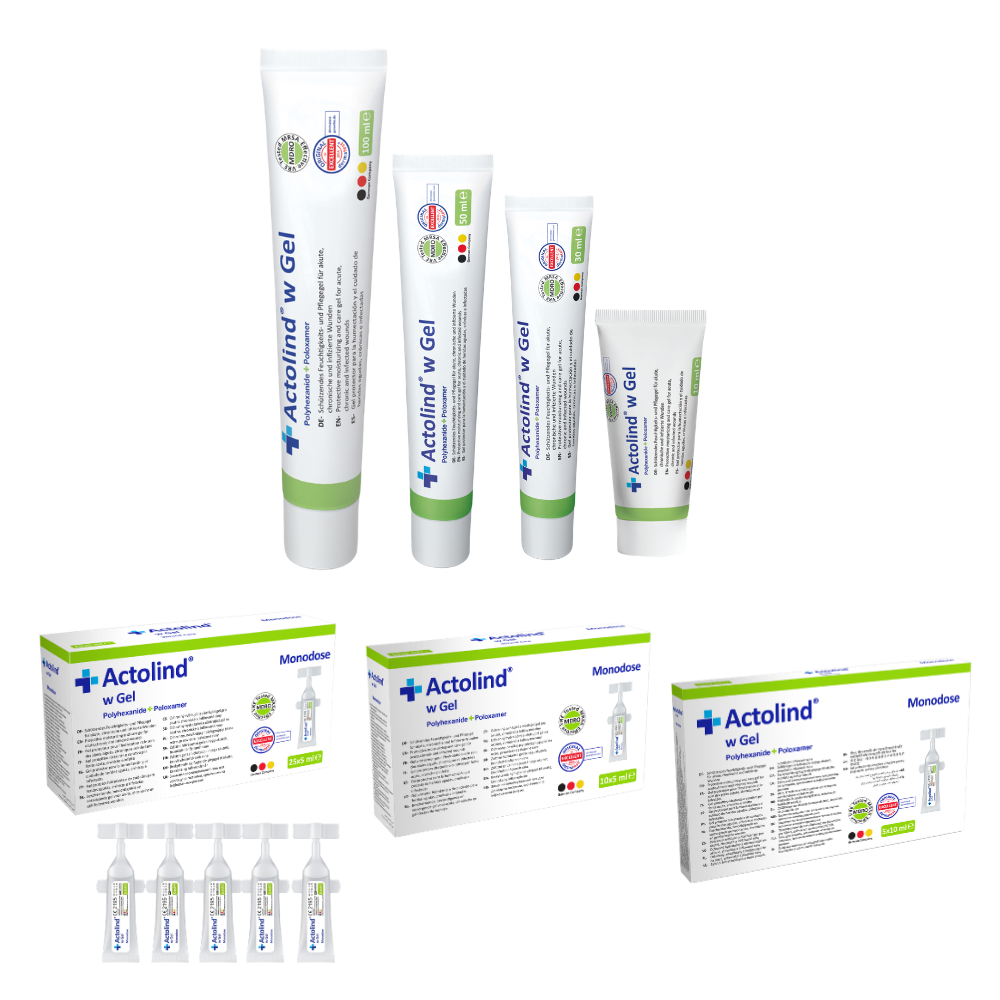
What tube sizes are available for Actolind W Gel?
Actolind W Gel is available in 10 ml, 30 ml, 50 ml, 100 ml, and 250 ml tube sizes.
Does Actolind W Gel have monodose (single-dose) packaging options?
Yes. Actolind W Gel is available in 25×5 ml, 10×5 ml, and 5×10 ml Monodose Strip packaging options.
What is the relationship between Actolind W Gel and Actolind Gel Plus?
Actolind W Gel and Actolind Gel Plus should not be considered products with completely different ingredients or purposes; they are related versions within the same Actolind gel product group. The Plus series is a portfolio alternative with increased moisturizing properties and viscosity through the addition of an additional surfactant.
How is Actolind W Gel different from gels containing Octenidine?
One of the key advantages of Actolind W Gel is its high biocompatibility with wound tissue while providing antimicrobial activity. Its combination of 0.1% Polyhexanide (PHMB) + Poloxamer is effective against bacteria, resistant microorganisms, and fungi without inhibiting granulation and epithelialization. This makes Actolind W Gel suitable for long-term use throughout different stages of wound healing. In products containing Octenidine, tissue tolerance and effects on granulation/epithelialization may vary depending on the formulation and concentration. Therefore, the advantage of Actolind W Gel is not limited to its antimicrobial activity but also includes its tissue-friendly properties that support wound healing.
Can Actolind W Gel be used with Negative Pressure Wound Therapy (NPWT)?
Yes. Actolind W Gel can be safely used in combination with Negative Pressure Wound Therapy (NPWT) in cyclic applications to support the formation of healthy granulation tissue.
Does Actolind W Gel remove old surgical scars?
No. Actolind W Gel is not a scar cream. It is a medical wound care gel designed to support the closure of open wounds in a moist and infection-controlled environment.
Can Actolind W Gel be used as a cosmetic blemish cream on the face?
No. Actolind W Gel is a Class III medical device intended for open wound care. It is not intended for aesthetic or cosmetic skin care purposes.
What is Actolind W Gel’s contribution to treatment costs?
Actolind W Gel may help reduce overall treatment costs by supporting more effective and efficient wound care management. In wound care, costs are determined not only by the product used but also by repeated dressing changes, healthcare personnel time, additional dressing materials, infection management, and prolonged treatment duration. The effective wound cleansing and biofilm management provided by Actolind W Gel and Actolind W Solution, together with maintenance of a moist wound environment and support for long-term antimicrobial care, may help simplify the wound care process and contribute to more efficient use of healthcare resources.
Can Actolind W Gel be used on diabetic foot wounds?
Yes. Actolind W Gel can be used in the care of diabetic foot wounds. Because the risk of infection and biofilm formation can delay healing in diabetic wounds, regular wound cleansing and appropriate wound care are particularly important. Thanks to its formulation containing Polyhexanide (PHMB) and Poloxamer, Actolind W Gel supports the control of microbial load and biofilm on the wound surface while helping maintain a moist wound-healing environment. This approach was also demonstrated in a case study presented at the 2024 18th National and 6th International Wound Congress. In the study, the wound bed was prepared with Actolind W Solution and Actolind W Gel, followed by skin grafting, resulting in successful wound healing.
Can Actolind W Gel be used on pressure wounds (decubitus ulcers)?
Yes. Actolind W Gel can be used in the care of pressure wounds. Regular wound cleansing, biofilm control, and maintenance of a moist wound-healing environment are fundamental components of pressure wound management. Actolind W Gel helps cleanse the wound surface while supporting an appropriate environment for the development of granulation tissue. Particularly in chronic wound care, it can help support effective wound management when used together with regular dressing applications.
Can Actolind W Gel be used on venous ulcers?
Yes. Actolind W Gel can be used in the wound care of venous ulcers. In these chronic wounds associated with venous insufficiency, prolonged exudate and biofilm formation may adversely affect the healing process. Thanks to its formulation containing Polyhexanide (PHMB) and Poloxamer, Actolind W Gel helps cleanse the wound surface and supports the control of microbial load and biofilm. It also helps maintain a moist wound-healing environment, supporting granulation and epithelialization processes. Treatment of venous ulcers should be carried out together with compression therapy and other approaches planned by the physician.
Can Actolind W Gel be used on arterial ulcers?
Yes. Actolind W Gel can be used for appropriate wound care of arterial ulcers. Since these wounds develop due to impaired arterial circulation, correcting the underlying circulation problem is the primary treatment. Keeping the wound surface clean and managing infection risk are also important. Actolind W Gel supports wound care by helping maintain a moist wound-healing environment and control the microbial load on the wound surface. Treatment of arterial ulcers should be planned by a vascular surgeon or other relevant specialist.
Can Actolind W Gel be used on surgical wounds?
Yes. Actolind W Gel can be used in the care of surgical wounds. During the healing process following surgical procedures, keeping the wound surface clean, maintaining an appropriate moisture balance, and managing the risk of infection are important. Thanks to its formulation containing Polyhexanide (PHMB) and Poloxamer, Actolind W Gel supports wound care, helps control microbial load, and reduces dressing adherence to the wound surface, contributing to more manageable dressing changes.
Can Actolind W Gel be used on traumatic wounds?
Yes. Actolind W Gel can be used in the care of acute wounds caused by traffic accidents, falls, crushing injuries, and similar trauma. Foreign material, tissue debris, and microbial contamination in traumatic wounds may adversely affect wound healing. Actolind W Gel supports cleansing of the wound surface, helps maintain a moist wound-healing environment, and contributes to the control of biofilm formation. This approach was also demonstrated in a case study on diabetic foot trauma presented at the 2024 18th National and 6th International Wound Congress, where the wound was prepared using Actolind W Solution and Actolind W Gel, followed by successful skin grafting.
Can Actolind W Gel be used after debridement?
Yes. After debridement, keeping the wound bed clean and controlling the reformation of biofilm are important for continued wound healing. Actolind W Gel helps maintain a moist wound-healing environment after debridement, supports microbial load control, and helps create an appropriate wound environment for the development of granulation tissue. It also reduces dressing adherence to the wound bed, contributing to less traumatic dressing changes.
Can Actolind W Gel be used for wound bed preparation?
Yes. Actolind W Gel can be used as an important part of wound bed preparation. Thanks to its formulation containing Polyhexanide (PHMB) and Poloxamer, it helps cleanse the wound surface and supports the control of biofilm and microbial load. This contributes to the development of granulation tissue and helps create an appropriate environment for subsequent wound care procedures. This approach was also used in a case study presented at the 2024 18th National and 6th International Wound Congress, where the wound bed was prepared with Actolind products before successful skin grafting.
Does Actolind W Gel support granulation tissue formation?
Yes. Healthy granulation tissue is one of the fundamental stages of wound healing. Actolind W Gel helps cleanse the wound surface, supports the control of biofilm and microbial load, and maintains a moist wound-healing environment. In this way, it contributes to creating appropriate wound conditions for the development of granulation tissue and supports the wound-healing process.
Does Actolind W Gel support the epithelialization process?
Yes. By helping maintain moisture balance on the wound surface, Actolind W Gel creates an appropriate healing environment that supports the epithelialization process. When used together with regular wound care, it helps keep the wound surface clean and supports the physiological progression of wound healing. This was also observed in an Aplasia Cutis Congenita case poster presented at the 2025 19th National, 7th International Wound Congress, where epithelialization was reported to begin at the wound margins during follow-up, with a large portion of the wound becoming epithelialized in the following days.
Can Actolind W Gel be used on infected wounds?
Yes. Actolind W Gel can be used in the care of infected wounds or wounds at risk of infection. Its Polyhexanide (PHMB) content supports control of the microbial load on the wound surface, while Poloxamer helps remove biofilm and wound residues. When used together with regular wound care, it contributes to reducing infection risk and creating a more suitable environment for wound healing. In cases of advanced infection, appropriate medical treatment must be planned by a healthcare professional.
Can Actolind W Gel be used on tunneled wounds?
Yes. Actolind W Gel can be used in the care of tunneled wounds (wounds with sinus tracts). Since biofilm, exudate, and tissue debris may accumulate within the wound cavity, regular wound cleansing is particularly important. Thanks to its formulation containing Polyhexanide (PHMB) and Poloxamer, Actolind W Gel supports wound surface cleansing, microbial load control, and maintenance of a moist wound-healing environment. When necessary, it should be used with appropriate cavity dressings according to the recommendations of a healthcare professional.
Can Actolind W Gel be used on necrotic wounds?
Yes. Actolind W Gel can be used in the care of wounds containing necrotic tissue. Necrotic tissue may facilitate biofilm formation and delay wound healing. Actolind W Gel helps cleanse the wound surface and supports biofilm management, contributing to the preparation of the wound bed for healing. When necessary, it may be used together with surgical, mechanical, or autolytic debridement methods.
Can Actolind W Gel be used on exudative wounds?
Yes. Actolind W Gel can be used in the care of exudative wounds. While helping maintain an appropriate moisture balance on the wound surface, its formulation containing Polyhexanide (PHMB) and Poloxamer supports wound cleansing and microbial load control. Using it together with an appropriate secondary dressing selected according to the amount of exudate can help improve wound care management.
Can Actolind W Gel be used on dry wounds?
Yes. Actolind W Gel helps moisturize a dry wound surface and supports the physiological wound-healing process. Maintaining a moist wound-healing environment is one of the fundamental principles that supports cell migration and new tissue formation. Actolind W Gel contributes to wound care by helping maintain moisture balance on the wound surface.
Does Actolind W Gel prevent dressings from sticking to the wound?
Yes. Actolind W Gel forms a protective gel layer on the wound surface, helping reduce adhesion of the dressing to the tissue. This contributes to reducing mechanical trauma and associated discomfort during dressing changes. It is particularly useful for more controlled wound care in acute and chronic wounds with sensitive tissue.
Does Actolind W Gel help reduce pain during dressing changes?
Indirectly, yes. Actolind W Gel keeps the wound surface moist and reduces adhesion of the dressing to the wound bed, helping decrease tissue trauma that may occur during dressing changes. This can contribute to more comfortable dressing changes. However, Actolind W Gel is not a painkiller and does not have a direct analgesic effect.
Can Actolind W Gel be used for wound care after amputation?
Yes. Actolind W Gel can be used in open wound care following amputation. Keeping the wound surface clean, controlling biofilm formation, and maintaining an appropriate moisture balance are important for the healing process after amputation. Actolind W Gel supports wound care by helping create a suitable environment for granulation tissue development and, with regular use, supports microbial load control. Its use should be planned according to the recommendations of the surgeon or wound care team.
No results found for this search.